Major Bhakti Movement Saints and Poets in India
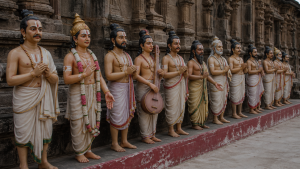
The Bhakti movement was one of the most influential religious and cultural currents in medieval India. Centered on personal devotion to God, it challenged ritualism, caste barriers and linguistic elitism, and gave rise to a rich tradition of saint-poets across regions.
Its spread from South India to the north, east and west produced important devotional schools, vernacular literature and social reform ideas that remain highly relevant for Prelims revision.
Southern Bhakti Tradition
- The Alvars: Twelve Vaishnavite poet-saints of South India who composed hymns in praise of Lord Vishnu. Their works were compiled into the Divya Prabandham by Nathamuni. Andal was the only woman among them.
- The Nayanars: Sixty-three Shaivite poet-saints whose devotional songs were later arranged into eleven books called the Tirumurai by Nambi Andar Nambi. The first seven volumes are known as the Tevaram.
- Andal: The sole female Alvar, remembered for Thiruppavai and Nachiyar Tirumozhi. Her poetry is a major part of Tamil devotional literature.
- Ramanujacharya: A major Vaishnava philosopher who propounded Vishishtadvaita or Qualified Non-Dualism. He stressed devotion (bhakti) as the path to liberation. His works include Sri Bhashya and Gita Bhashya.
- Basavanna: A 12th-century saint in Karnataka who founded the Veerashaiva or Lingayat movement. He emphasised social equality and set up the Anubhava Mantapa for spiritual and social discussion.
- Mahadevi Akka: A prominent woman saint associated with the Veerashaiva tradition. She is noted for her devotional and mystical poetry.
Northern Bhakti Movement and Vernacular Devotion
- Ramananda: A key pioneer of Bhakti in North India who founded the Ramanandi Sampradaya. He popularised the worship of Rama and Sita and used Hindi for preaching.
- Inclusive approach: Ramananda accepted disciples across caste and gender lines, and his tradition is linked with later saints such as Kabir and Ravidas.
- Kabir: A 15th-century saint-poet who strongly supported Nirguna Bhakti, or devotion to a formless God. He rejected caste distinctions, empty ritual and sectarian labels.
- Kabir’s writings: His verses are preserved in Bijak and Kabir Granthavali, and several of his hymns are included in the Guru Granth Sahib.
- Ravidas: An influential Nirguna saint from Varanasi who advocated a classless society. His imagined ideal city, Begumpura, symbolised freedom from sorrow and discrimination.
Bhakti in the East and West
- Srimanta Sankardev: A saint-scholar from Assam who propagated Ekasarana Dharma, a monotheistic Vaishnava tradition centred on Krishna. He also contributed to Assamese devotional culture through Borgeet, Ankia Naat and the Sattra monastic tradition.
- Sattras: Monastic institutions established in Assam that continue to function as centres of religion, art and culture.
- Chaitanya Mahaprabhu: A major saint of Bengal who popularised Gaudiya Vaishnavism. He made sankirtana—congregational singing and dancing—the main form of worship.
- Mirabai: A Rajput princess and mystic poet from Rajasthan who expressed intense devotion to Krishna in the Saguna Bhakti tradition.
- Madhurya bhava: Mirabai’s devotion is associated with the devotional sentiment of sweet love and surrender to Krishna.
- Bhaktamal: Written by Nabhadas in Braj Bhasha around 1600 CE, this work contains brief biographies of more than 200 Bhakti saints, including Mirabai.
Literature, Language and Worship Forms
- Vernacular expansion: Bhakti saints used Tamil, Kannada, Hindi, Braj Bhasha, Assamese and Bengali, making devotion accessible to ordinary people.
- Devotional poetry: The movement produced hymns, vachanas, kirtans and songs that became central to regional literary traditions.
- Basavanna’s Vachanas: These short Kannada compositions were written for common people and carried reformist ideas.
- Sankardev’s Kirtan Ghosha: One of the most important texts of Assamese Vaishnavite devotion.
- Brajavali: The artificial literary language used in Sankardev’s Ankia Naat plays.
- Saguna and Nirguna: Bhakti traditions are often divided between devotion to a deity with attributes (Saguna) and devotion to a formless supreme reality (Nirguna).
| Saint / Philosopher | School / Sect | Important Texts / Contributions |
| Ramanujacharya | Vishishtadvaita | Sri Bhashya, Gita Bhashya |
| Basavanna | Veerashaivism | Vachanas, Anubhava Mantapa |
| Srimanta Sankardev | Ekasarana Dharma | Kirtan Ghosha, Borgeet, Ankia Naat |
| Kabir | Nirguna Monotheism | Bijak, Kabir Granthavali, hymns in Guru Granth Sahib |
Key Prelims Takeaways
- Alvars: Twelve Vaishnavite saints; their hymns were compiled as Divya Prabandham.
- Andal: The only female Alvar; known for Thiruppavai and Nachiyar Tirumozhi.
- Nayanars: Sixty-three Shaivite saints; their works form the Tirumurai.
- Basavanna: Linked with the Lingayat movement and the Anubhava Mantapa.
- Kabir and Ravidas: Major Nirguna saints who rejected caste and ritualism.
- Sankardev: Associated with Ekasarana Dharma, Sattras and Assamese devotional literature.
- Bhaktamal: Important biographical text on Bhakti saints by Nabhadas.
Current General Studies comprises current-affairs-based, General Studies-rich study material on policies, laws, institutions, economy, science, environment, governance, international relations, and other varied but important topics for UPSC and State PSC Prelims examinations.
Fortnightly PDF compilations: Available here
Originally written on
March 7, 2026
and last modified on
September 5, 2026.
| Related | |
|---|---|