Ahom Dynasty Heritage Sites in Assam
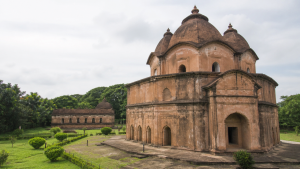
The Ahom dynasty shaped the Brahmaputra Valley for nearly six centuries and left behind a distinctive legacy of capital planning, masonry, water bodies, and funerary architecture. The heritage landscape associated with Ahom rule is concentrated around Sivasagar and Charaideo in present-day Assam.
Historical Background of the Ahom Dynasty
The Ahom dynasty ruled Assam from 1228 to 1826. Founded by Chaolung Sukaphaa, a Shan prince from Mong Mao, the dynasty crossed the Patkai hills and established its political base in Assam. Its long rule saw the integration of diverse ethnic groups and repeated resistance to external invasions.
The Ahoms successfully defended the region against Mughal expansion, with the Battle of Saraighat (1671) standing out as a key victory under Lachit Borphukan. Ahom rule finally ended with the Treaty of Yandabo (1826), after which Assam came under British control. During its peak, Sivasagar, earlier known as Rangpur, functioned as the political, military, and ceremonial capital.
Rangpur-Sivasagar Historical Ensemble
The Rangpur-Sivasagar landscape reflects Ahom planning through palaces, pavilions, stone bridges, and large artificial tanks. It is an important example of medieval Assamese architecture and engineering.
- Rang Ghar: Built by Swargadeo Pramatta Singha in 1744, this two-storeyed structure is regarded as Asia’s oldest surviving amphitheatre. It was used as a royal pavilion for viewing sports, wrestling matches, and buffalo fights during Rongali Bihu.
- Talatal Ghar: A multi-storeyed palace complex linked with Ahom military architecture. It was originally built as an army base by Swargadeo Rudra Singha and later expanded by Swargadeo Rajeswar Singha.
- Kareng Ghar: The upper palace structure associated with Talatal Ghar, used as the royal residence.
- Secret tunnels: The underground storeys of Talatal Ghar were designed with escape routes for strategic retreat.
- Namdang Stone Bridge: Built in 1703 by Swargadeo Rudra Singha, this bridge over the Namdang River was carved from a single block of sandstone. It still carries traffic on National Highway 37.
- Sivasagar tank: Built by Queen Ambika in 1734, it is one of the best-known artificial reservoirs of the Ahom period.
- Joysagar tank: Constructed by Swargadeo Rudra Singha in 1697 in memory of his mother, Joysmoti.
- Gaurisagar tank: Another major man-made reservoir within the historic ensemble.
- Temples around Sivasagar tank: The tank is surrounded by Shivadol, Vishnudol, and Devidol.
Charaideo Moidams and Funerary Heritage
Charaideo Moidams represent the funerary landscape of the Ahom dynasty. These are vaulted mound-burial systems or tumuli containing the remains of Ahom kings, queens, and nobles.
- Structure: A hemispherical earthen mound covers a brick or stone chamber, often topped by an octagonal dwarf wall called Prachir.
- Burial practice: The moidams were used for royal burials before the adoption of Hindu customs led to a decline in burial and a shift towards cremation.
- Historical significance: The site reflects Ahom concepts of kingship, ritual, and memorial architecture.
- Comparative note: These burial mounds are often compared with the royal pyramids of ancient Egypt because of their mound form and the practice of placing valuables with the deceased ruler.
Exam fact: Charaideo Moidams were inscribed as India’s 43rd UNESCO World Heritage Site on 26 July 2024.
UNESCO Tentative List and Criteria
The UNESCO Tentative List is the inventory of properties that a State Party may nominate for the World Heritage List in the future. A property must first be on this list before formal nomination.
- Nomination: India’s Permanent Mission to UNESCO submitted the dossier for the Rangpur-Sivasagar Historical Ensemble on 19 June 2026.
- Criteria (iii): Refers to a property bearing unique or exceptional testimony to a cultural tradition or civilisation.
- Criteria (iv): Refers to an outstanding example of a building, architectural or technological ensemble, or landscape.
- Tentative List count: With this addition and three other Indian properties, India’s Tentative List increased to 73 properties.
- Other additions: The Colonial Penal Settlement of the Andaman Islands, Nicobarese Cultural Continuity in the Central Group of Nicobar Islands, and Painted Haveli Towns of Shekhawati.
Why the Ensemble Matters
- Capital landscape: It preserves the pre-modern urban and ceremonial setting of Ahom rule.
- Engineering: The site shows advanced masonry and water management through palaces, bridges, and tanks.
- Military architecture: Structures like Talatal Ghar reflect fortification and strategic planning.
- Cultural continuity: The ensemble links political history, ritual spaces, and royal memory in one historic landscape.
- Regional significance: It strengthens Assam’s place in India’s heritage map alongside Charaideo Moidams.
Key Prelims Takeaways
- Ahom dynasty: Ruled the Brahmaputra Valley from 1228 to 1826.
- Founder: Chaolung Sukaphaa.
- Capital region: Sivasagar, earlier known as Rangpur.
- Rang Ghar: Built in 1744; considered Asia’s oldest surviving amphitheatre.
- Talatal Ghar: Multi-storeyed palace complex associated with Ahom military architecture.
- Namdang Stone Bridge: Built in 1703 from a single sandstone block; still in use.
- Charaideo Moidams: Inscribed as India’s 43rd UNESCO World Heritage Site on 26 July 2024.
Recent Context
In September 2026, the Rangpur-Sivasagar Historical Ensemble in Assam was added to UNESCO’s World Heritage Tentative List. India submitted the nomination dossier on 19 June 2026 under UNESCO cultural criteria (iii) and (iv).
With this addition and three other properties, India’s Tentative List rose to 73. The move keeps the Ahom capital landscape in contention for future nomination to the World Heritage List.
| Related | |
|---|---|