Varsha Ashok Aglawe Becomes First Woman GSI Director General
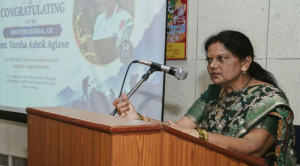
Varsha Ashok Aglawe assumed charge as the 54th Director General of the Geological Survey of India on 31 July 2026. She became the first woman to head the Geological Survey of India in its 176-year history. She succeeded Asit Saha, who served as Director General from 27 July 2024 to 31 July 2026.
Geological Survey of India
The Geological Survey of India was established in 1851 and functions as the national organisation for geological mapping, mineral resource assessment, and geoscientific studies in India. It operates under the Ministry of Mines and is one of the oldest scientific organisations in the country. The organisation also supports exploration for strategic and critical minerals used in industry and energy systems.
Professional Background of Varsha Ashok Aglawe
Varsha Ashok Aglawe joined the Geological Survey of India in 1992 after working with the Indian Bureau of Mines. She served as Additional Director General and Head of Department for the Eastern Region in Kolkata before her elevation to the top post. Her professional experience in geoscience spans more than three decades.
Specialisation and Geological Work
Aglawe specialises in palaeontology and palynology. Palaeontology is the study of fossils, while palynology is the study of pollen, spores, and other microscopic organic particles. Her work includes the identification of the Salbardi-Ghorpend area in Central India as a new dinosaur nesting site.
Important Facts for Exams
- The Geological Survey of India was founded in 1851 and is headquartered in Kolkata.
- The Geological Survey of India is a subordinate office under the Ministry of Mines.
- Palaeontology deals with fossils, extinct organisms, and ancient life forms.
- Palynology is used in geology, archaeology, and climate studies through the analysis of pollen and spores.
Current Priorities in Mineral Exploration
Aglawe linked the Geological Survey of India’s work with critical mineral exploration and mineral security. Critical minerals include minerals such as lithium, cobalt, nickel, graphite, and rare earth elements that are used in electronics, batteries, and clean energy technologies. Offshore mineral exploration and laboratory infrastructure are also part of the organisation’s geoscientific work.
| Related | |
|---|---|