US Energy Department Adds Helium to Critical Materials List
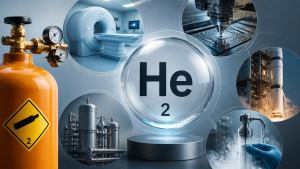
On 23 October 2026, US Secretary of Energy Chris Wright designated helium a critical material under the Energy Act of 2020. Helium became the 20th material on the US Department of Energy’s critical materials list. The designation provides helium producers access to additional federal funding and subjects the material to closer government oversight.
Helium: properties and occurrence
Helium is a colourless, odourless and non-flammable noble gas with the chemical symbol He and atomic number 2. It is the second-lightest element, after hydrogen, and belongs to Group 18 of the periodic table. Helium has the lowest boiling point of any element, approximately −268.9°C at standard atmospheric pressure.
Most terrestrial helium forms through the radioactive decay of uranium and thorium in rocks. It can accumulate in underground natural gas reservoirs, from which it is recovered during gas processing. The United States has substantial helium-rich natural gas resources, but limited refining capacity and lengthy permitting timelines constrain domestic output.
Critical material designation
The Energy Act of 2020 provides the statutory framework for identifying critical materials. The Department of Energy determined that helium meets the statutory definition because it is essential to American manufacturing and faces supply-chain risks. Its role in semiconductor manufacturing was a key reason for the designation; many applications have no viable substitutes.
Metallurgical coal was the previous addition to the list, in 2025. Fluorine is the only other gas on the list. The designation forms part of US efforts to reduce reliance on foreign critical materials and support domestic production.
Industrial uses and supply chains
Helium is used in semiconductor manufacturing, medical imaging, scientific research and space exploration. Liquid helium cools superconducting magnets used in magnetic resonance imaging (MRI) systems. Helium also has applications in wind, solar and nuclear energy technologies.
Global helium demand is growing faster than production. Supply risks include geopolitical tensions, closure of the Strait of Hormuz and Russian export controls. Helium’s industrial uses and constrained refining capacity are relevant to assessments of supply-chain security.
Important Facts for Exams
- Helium’s chemical symbol is He, and its atomic number is 2.
- Helium belongs to Group 18, the noble gases, in the periodic table.
- Liquid helium is used to cool superconducting magnets in MRI systems.
- Fluorine is the only other gas on the US Department of Energy’s critical materials list.
The Energy Act of 2020 is the statutory basis cited for helium’s critical material designation. Helium is recovered from certain natural gas reservoirs during processing.
| Related | |
|---|---|