UNESCO Recognises Mysuru’s Arthashastra Manuscript
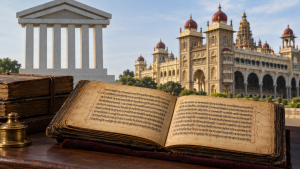
UNESCO confirmed on 5 November 2026 that a manuscript of Kautilya’s Arthashastra, preserved at the Oriental Research Institute (ORI) in Mysuru, had been added to the Memory of the World Committee for Asia and the Pacific (MOWCAP) Regional Register.
Regional register inclusion
The recognised manuscript is a 16th-century palm-leaf copy discovered in 1905 by scholar and librarian Rudrapatnam Shamasastry at the Oriental Research Institute, University of Mysore. The Arthashastra is an ancient Indian work on governance, administration and statecraft. Manuscripts of the Mahabharata and Kalhana’s Rajatarangini were also added to the regional register on 5 November, bringing India’s total entries to six.
Preservation and nomination
The Oriental Research Institute in Mysuru has preserved and digitised the manuscript. The Indira Gandhi National Centre for the Arts (IGNCA) prepared the nomination dossiers for the Arthashastra and the other newly recognised manuscripts.
Important Facts for Exams
- Palm-leaf care: ORI applies lemongrass oil to palm leaves; it acts as a pesticide, restores their natural fluidity and helps keep them dry against humidity-related decay.
- Digital restoration: ORI uses software to reassemble disjointed manuscript pieces and correct or fill missing text during restoration.
- Textual structure: The Arthashastra is organised into 15 books covering subjects from training the ruler and administration to law, diplomacy and military affairs.
- Seven-limbed state: Its saptanga theory models the state through seven interdependent elements: ruler, ministers, territory and population, fort, treasury, army and allies.
| Related | |
|---|---|