Supreme Court Dismisses Challenge to Rajasthan ACB Authority
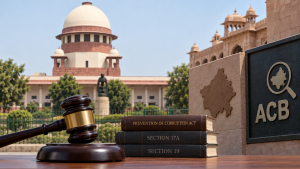
On 19 January 2026, the Supreme Court of India dismissed two special leave petitions challenging the Rajasthan Anti-Corruption Bureau’s authority to investigate alleged offences involving central government employees in Rajasthan.
Challenge to the ACB’s authority
The petitions challenged a 3 October 2025 Rajasthan High Court decision and argued that the state ACB needed prior Central Bureau of Investigation permission to investigate. Their dismissal left the High Court decision in place for these cases involving alleged offences within Rajasthan. The outcome was confined to these petitions and did not establish a blanket exemption from statutory approval or sanction requirements.
Important Facts for Exams
- Prevention of Corruption Act, Section 17A: Under Section 17A, prior approval is required for inquiry or investigation into specified official-function decisions, except cases involving acceptance of undue advantage on the spot.
- Prevention of Corruption Act, Section 19: Under Section 19, prior government sanction generally bars a court from taking cognisance of specified Prevention of Corruption Act offences against public servants; it is distinct from investigation approval.
- State consent for CBI investigations: Under the Delhi Special Police Establishment Act, CBI ordinarily needs a state’s consent to exercise jurisdiction there; a constitutional-court-ordered investigation is an exception.
- Article 136 jurisdiction: Article 136 gives the Supreme Court discretionary power to grant special leave from judgments of courts and tribunals, rather than creating an appeal as of right.
Originally written on
January 19, 2026
and last modified on
November 19, 2026.
| Related | |
|---|---|