SpaceX Starship Deploys 20 Starlink Satellites
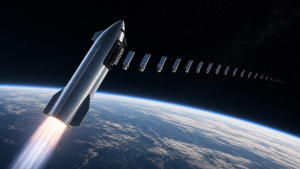
SpaceX launched Starship from Starbase, Texas, on 24 July 2026 for Flight 13, its 13th test mission. The upper stage deployed 20 upgraded Starlink V3 satellites into suborbital space, and the mission included an in-space Raptor engine relight test.
Starship and Super Heavy
Starship is a fully reusable launch system developed by SpaceX for orbital missions, lunar missions, and deep-space transport. The system has two stages, namely the Starship upper stage and the Super Heavy booster, which provides the initial lift-off thrust.
Starlink V3 Satellites
Starlink is SpaceX’s satellite internet constellation, and the V3 satellites are the next-generation version designed for higher bandwidth and faster internet speeds. Six of the deployed satellites carried cameras to transmit live views of Starship back to Earth during the test flight.
Flight Profile and Re-entry
The Starship upper stage completed re-entry and made a soft splashdown in the Indian Ocean while remaining intact and transmitting telemetry. The Super Heavy booster performed a directional flip and a boostback burn before a hard splashdown in the Gulf of Mexico after fewer engines ignited than planned during the landing burn.
Important Facts for Exams
- Starbase is SpaceX’s launch site in Texas and is used for Starship test missions.
- Starship Flight 13 was the second test of the Starship Version 3 design.
- Telemetry is the remote transmission of data from a spacecraft to ground stations.
- Suborbital space refers to a trajectory that reaches space but does not complete an orbit around Earth.
Test Objectives
The mission tested hardware and software changes introduced after Flight 12 in May 2026. The deployed Starlink satellites followed the same suborbital trajectory as Starship and were intended to burn up during re-entry after data collection.
| Related | |
|---|---|