Singapore Launches Biological Data Centre with Living Neurons
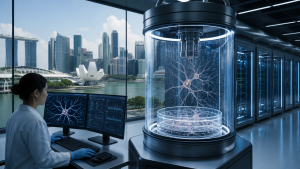
Singapore has launched a biological data centre prototype at the National University of Singapore’s Centre for Life Sciences. The system uses living human neurons grown from stem cells and connected to silicon hardware for data processing.
Biological Computing
Biological computing uses living cells, biomolecules, or biological processes to perform computation. Wetware is a term used for systems that combine biological material with electronic hardware, and it differs from conventional silicon-based computing.
Prototype Structure and Operation
The prototype consists of a 20-unit rack of CL1 biological computing systems. Each CL1 unit contains about 800,000 neurons, and the full rack uses approximately 16 million living human neurons.
The cells require laboratory maintenance, including a liquid mixture of sugar, micronutrients, and pH buffers every three days. A gas-mixing life support system supports the living cells inside the laboratory setup.
Partners and Technical Roles
Professor Rickie Patani of NUS Medicine oversees the culturing and maintenance of the living cells. DayOne manages the data centre infrastructure, and Cortical Labs provides the biological hardware.
The prototype was officially launched on 16 July 2026 inside the NUS Centre for Life Sciences. It was later showcased on 6 August 2026 at the NUS Life Sciences Institute.
Important Facts for Exams
- The National University of Singapore is a public research university in Singapore and is among Asia’s major higher education institutions.
- Stem cells can differentiate into specialised cell types, including neurons, under laboratory conditions.
- Silicon hardware remains the standard base for most modern data centres and digital processors.
- Green data centre policies focus on reducing power use, cooling demand, and carbon emissions in digital infrastructure.
Energy Use and Research Applications
A single CL1 unit draws about 25 watts, while a fully populated rack draws about 800 to 1,000 watts. Published workload-per-watt benchmarks for comparison with conventional processors have not yet been released.
The planned research uses include neuro-inspired artificial intelligence, biomedical modelling, drug discovery, and neurological disease research. Singapore’s Green Data Centre Roadmap provides the policy context for the project.
| Related | |
|---|---|