Shivamogga Agricultural University Releases New Sahyadri Annapurna Rice Variety, Bringing Total Developed to Eight
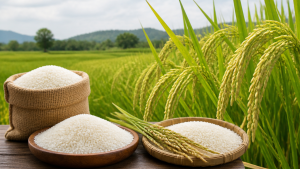
Keladi Shivappa Nayaka University of Agricultural and Horticultural Sciences (KSAUHS), based in Shivamogga, Karnataka, released Sahyadri Annapurna, a small-grained white paddy variety, for farmers at a Krishi Mela in 2026. It is the university’s eighth rice variety; the university was established in 2014.
Yield, maturity and development
Research on the variety began in 2018. It matures in 120–125 days and has an average yield of 25–30 quintals per acre, or 70–75 quintals per hectare. It is resistant to stem borer, leaf folder, planthoppers and blast disease. The rice is intended for consumption, with a grain profile compared to Sona Masuri, and its soft texture also makes it suitable as livestock feed.
Development involved the Indian Institute of Rice Research in Hyderabad, KSAUHS’s Zonal Agricultural and Horticultural Research Station in Shivamogga, and its Kattalagere Research Centre. The variety is currently cultivated on about 2,000 acres in the Bhadra command area.
Important Facts for Exams
- ICAR rice coordination: The Indian Institute of Rice Research is an ICAR institute that coordinates the All India Coordinated Research Project on Rice, testing varieties across diverse agro-ecological zones.
- Variety notification: India distinguishes a crop variety’s release from its notification under the Seeds Act, 1966; notified seeds must meet prescribed germination and purity standards for sale.
- Blast resistance: Rice blast is caused by the fungus Magnaporthe oryzae; cultivar resistance can be race-specific, so pathogen populations may erode protection over time.
- Grain classification: Rice grain grading distinguishes kernel length from shape: ‘short’ is a length class, while ‘bold’ describes a low length-to-breadth ratio.
| Related | |
|---|---|