Odisha Launches Deep Sea Fishing Mission
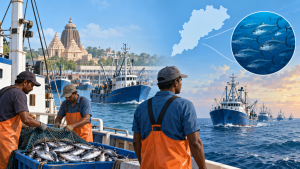
Odisha launched the Odisha Deep Sea Fishing Mission in Bhubaneswar on July 9, 2026. The event also marked the national launch of a Letter of Authorisation (LoA) for sustainable fishing in the high seas. Vice-President C. P. Radhakrishnan launched both the LoA and the mission document.
Mission targets and initial approvals
The mission aims to support sustainable use of deep-sea fisheries resources and strengthen Odisha’s blue economy. Chief Minister Mohan Charan Majhi outlined a ten-year target to deploy 150 advanced deep-sea fishing vessels and modernise 500 existing vessels. As an initial measure, eight Odisha fishers received LoAs, and two vessels received approval under the Chief Minister's Agriculture Enterprise Scheme. Odisha Governor Hari Babu Kambhampati, Union Ministers Dharmendra Pradhan and Rajiv Ranjan Singh, and state minister Gokulanand Mallick also attended.
Fisheries figures cited at the event
Rajiv Ranjan Singh said national fish production had risen from 95.79 lakh tonnes to about 180 lakh tonnes over 11 years, while sector income increased from ₹30,000 crore to ₹62,408 crore. He said marine product exports had grown by about ₹11,000 crore to ₹73,891 crore, with around 40% going to the United States. Dharmendra Pradhan cited Odisha’s annual fish production at about 12 lakh metric tonnes, with an estimated commercial value of ₹24,000 crore.
Important Facts for Exams
- Freedom to fish: Under the high-seas freedom principle, states have rights to fish, navigate, conduct overflights and carry out scientific research.
- High-seas stock cooperation: The 1995 UN Fish Stocks Agreement requires cooperation, generally through regional fisheries management organisations, to conserve straddling and highly migratory fish stocks on the high seas.
- Indian Ocean tuna governance: The Indian Ocean Tuna Commission is a regional fisheries management organisation responsible for conserving and managing tuna and tuna-like species across the Indian Ocean.
- Responsible fisheries code: FAO's Code of Conduct for Responsible Fisheries is voluntary, but sets internationally recognised principles spanning capture fisheries, aquaculture, processing and trade.
| Related | |
|---|---|