Saffron Cultivation Begins in Ladakh
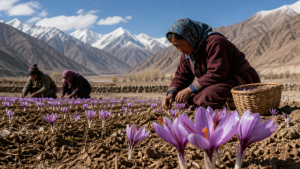
Saffron cultivation began in Ladakh on 2 October 2026 as a pilot project in Leh district. Around 90,000 premium Iranian saffron corms, weighing about 800 kg, were planted over 4,000 square metres at Command Area Gate No. 27 in Spituk Pharka. The project uses restored barren land and forms part of agricultural diversification in the Union Territory of Ladakh.
Saffron as a Crops and Spice
Saffron is obtained from the dried stigmas of Crocus sativus, a perennial flowering plant. It is one of the costliest spices in the world because each flower produces only a small quantity of stigma threads. Iran is the largest producer of saffron globally, and saffron cultivation in India is traditionally associated with Jammu and Kashmir.
Land Reclamation and Irrigation in Leh
The pilot site at Spituk Pharka was previously barren and was restored under Project Him Sarovar. The plantation is linked to the restoration of about 800 acres of land in Leh through water from the Igoo-Phey irrigation canal. The initiative also follows earlier high-value floriculture efforts in Leh, including Lilium and Gladiolus cultivation.
Institutional Support and Pilot Expansion
The initiative is being guided by Lieutenant Governor Vinai Kumar Saxena. The CSIR-Indian Institute of Integrative Medicine has worked with the Agriculture Department of the Union Territory since 2023 on saffron introduction and technology transfer in Leh and Kargil. In 2024, a Memorandum of Understanding was signed between the Ladakh Autonomous Hill Development Council and the Union Territory of Ladakh for land allocation in the Palam area for saffron farming.
Important Facts for Exams
- Saffron comes from the stigma of Crocus sativus, which is cultivated for its dried floral parts.
- Leh is located in Ladakh, a Union Territory of India created in 2019.
- Project Him Sarovar is linked with land restoration and water management in Ladakh.
- CSIR-IIIM stands for the CSIR-Indian Institute of Integrative Medicine.
Quality Standards and Earlier Trials
The saffron corms used in the pilot project met quality standards of 8-10 cm circumference, 2.5-3 cm or more diameter, and at least 10 grams weight. Earlier experimental cultivation in 2023 recorded successful harvests in Kargil, including a 90% success rate achieved by Mohammad Mehdi of Minjee through deeper planting of corms.
| Related | |
|---|---|