Researchers Discover New Sunflower Species in Arunachal Pradesh
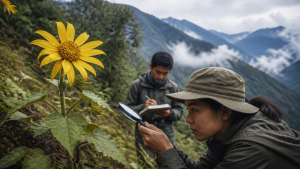
Researchers from the CSIR-Institute of Himalayan Bioresource Technology (IHBT), based in Himachal Pradesh, identified a new plant species of the sunflower family in Arunachal Pradesh. The species was named Doronicum sanctum and was formally described in a study published on 11 August 2026 in a Springer Nature journal.
Taxonomy and Plant Family
Doronicum sanctum belongs to the genus Doronicum, which is commonly called Leopard’s Bane. The genus is part of the family Asteraceae, one of the largest flowering plant families, and it includes many herbaceous species found in temperate and alpine regions.
Discovery Site and Habitat
The species was recorded in the Tawang district of Arunachal Pradesh at an elevation reported between about 4,000 metres and 4,086 metres above sea level. The type locality lies near the Chumi Gyatse Holy Waterfalls, a site associated with local religious traditions in the eastern Himalayas.
Diagnostic Features and Identification
The plant was distinguished by yellow flowers, heart-shaped leaves, pubescent ray cypselae, and a caducous pappus. Cypsela is the dry fruit typical of the Asteraceae family, and pappus is the modified calyx that often aids seed dispersal in many composite plants.
Important Facts for Exams
- Doronicum sanctum is the first documented member of the genus Doronicum from Northeast India.
- Earlier Indian records of Doronicum were restricted to the Western Himalayas.
- The species name sanctum means holy in Latin.
- The plant was identified during a botanical survey of Himalayan biodiversity hotspots.
Related Himalayan Plant Record
In 2021, another alpine plant from the Himalayan sunflower family, Cremanthodium indicum, was identified near Penga-Teng Tso Lake in the Tawang region. That species was assessed as critically endangered in the same year.
| Related | |
|---|---|