Rare Spot-bellied Eagle-Owl Photographed in Kozhikode
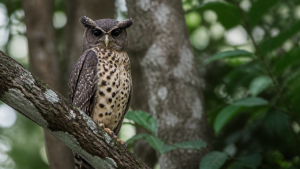
A Spot-bellied Eagle-Owl (“Bubo nipalensis” or “Ketupa nipalensis”) was photographed in Janakikkad forest, Kozhikode district, on 16 October 2026. The observation is the first photographic record of the species in the district. The owl is also known locally as “Kolliyan” and “Kattumoonga”.
Species and taxonomy
The Spot-bellied Eagle-Owl belongs to the order Strigiformes, which includes owls, and the family Strigidae, commonly known as typical owls. The species is found in parts of South and Southeast Asia, including India. At about 55–65 centimetres long and 1.5–2.5 kilograms in weight, it is the second-largest owl species found in India.
Identification and ecology
The owl has prominent ear tufts above its eyes and chevron-shaped markings across its pale underbelly. These features help distinguish it from other large owls. It is nocturnal and hunts mainly at night. Its prey includes snakes, other birds and small mammals. Dense evergreen forests, tropical valleys and shola forests are among its habitats.
Janakikkad forest and bird records
Janakikkad forest covers approximately 325 acres in Maruthonkara panchayat, Kozhikode district, along the Kuttiady River. The forest is known for its bird diversity, with more than 160 bird species recorded there. Wildlife photographer and birdwatcher Sunil Tito and Janakikkad ecotourism guide and birdwatcher Sudheesh A. discovered and photographed the owl.
Important Facts for Exams
- Strigiformes is the bird order that includes owls.
- Strigidae is a family of owls commonly called typical owls.
- The Spot-bellied Eagle-Owl is a nocturnal predator that eats snakes, birds and small mammals.
- Janakikkad forest lies along the Kuttiady River in Kozhikode district.
The Spot-bellied Eagle-Owl is identified by its ear tufts and spotted underbelly. Its scientific names include “Bubo nipalensis” and “Ketupa nipalensis”.
| Related | |
|---|---|