Production Linked Incentive Schemes in India
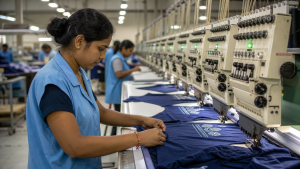
The Production Linked Incentive (PLI) scheme is one of India’s key industrial policy tools to strengthen manufacturing, attract investment and improve export competitiveness. It links government support to actual output, encouraging firms to expand production in India. In recent years, it has also become relevant to sectors such as textiles, footwear and leather, where scale, technology and jobs matter.
Overview of the PLI Scheme
The Production Linked Incentive (PLI) scheme was introduced by the Government of India in 2020 to build a stronger manufacturing base. Instead of giving support upfront, it rewards firms for increasing domestic production and sales of goods manufactured in India. The scheme is designed to make Indian industry globally competitive and reduce dependence on imports. It also aims to promote large-scale investment, technology upgradation and efficiency in production. In policy terms, PLI is meant to link public support with measurable industrial growth. The scheme is sector-specific. Different ministries and departments frame PLI for different industries based on their strategic importance, export potential and employment generation capacity. This makes the model flexible, while keeping the core principle uniform: incentives are tied to incremental performance.
How the Incentive Works
PLI incentives are generally linked to incremental production and incremental sales over a fixed period, usually five years. In simple terms, a company gets the benefit only when it expands production beyond a prescribed base year. This structure serves several policy goals:
- Performance-based support: companies must show actual growth to claim incentives.
- Long-term investment: the five-year window encourages firms to plan for scale and capacity expansion.
- Domestic value addition: the framework supports local manufacturing rather than imports.
- Export competitiveness: higher output and better efficiency can improve global market access.
- Technology adoption: firms are encouraged to use better processes and modern manufacturing systems.
- Employment generation: large-scale production can create jobs directly and indirectly.
The broader policy intent is to create an ecosystem where manufacturing becomes stronger, more competitive and less dependent on foreign supply chains. For exam purposes, the important point is that PLI is not a subsidy for mere establishment of units; it rewards actual industrial output.
PLI and the Textiles Sector
The textiles sector has already been brought under the PLI framework. In April 2026, 52 new firms were approved under Round 3 of the textile PLI scheme. This round focuses on Man-Made Fibre (MMF) apparel fabrics and technical textiles. Technical textiles are fabrics made for functional use rather than appearance. They are important in industrial and performance-related applications. In footwear manufacturing, such textiles are used in uppers, linings, reinforcements and performance layers. This linkage matters because footwear is no longer only a traditional leather-based industry. It increasingly depends on material innovation, design efficiency and performance-oriented production. Technical textiles therefore have a direct role in upgrading the sector’s manufacturing profile.
Footwear and Leather: Policy Discussion
A proposed PLI scheme for the leather and footwear sector is under discussion with an estimated outlay of about ₹2,600 crore. As of September 2026, it has not yet been officially notified. Cabinet notes for extending PLI support to the footwear and leather sectors were reported to be in an advanced stage of finalisation in August 2023. The proposal reflects the government’s interest in using industrial incentives to support a labour-intensive sector with export potential. This is significant from a Prelims and mains perspective because footwear and leather manufacturing sit at the intersection of industrial policy, exports and employment. If brought under PLI, the sector could benefit from stronger domestic production, better scale and higher investor interest.
Exam point: A proposed PLI scheme for leather and footwear, with an estimated outlay of about ₹2,600 crore, is under discussion but not yet notified.
Indian Footwear Industry: Key Facts
India is the world’s second-largest footwear producer, accounting for about 12% to 13% of global footwear production. The sector employs around 4.42 million people, making it important for job creation and industrial growth. India’s share in global footwear exports is still modest at about 2% to 2.15%, which shows both the existing base and the scope for expansion. The sector has a strong domestic market as well, which helps support scale production. Recent export data shows momentum. India’s leather and footwear exports rose by 25% to reach USD 5.7 billion in FY25, exceeding the government’s target. The Council for Leather Exports (CLE) expects exports to cross USD 6.5 billion in FY26 and aims for USD 13.7 billion by 2030. The domestic footwear market was valued at USD 20.11 billion in 2025 and is projected to reach USD 22.67 billion in 2026. This combination of large domestic demand and export potential makes the sector a strong candidate for incentive-based industrial policy.
Institutions and Sectoral Support
The India Trade Promotion Organisation (ITPO) is the Government of India’s apex trade promotion body and functions under the Ministry of Commerce and Industry. It plays an important role in trade fairs, export promotion and industry outreach. The Confederation of Indian Footwear Industries (CIFI) was incorporated in January 2014. Its objective is to promote cooperation and collective development in the footwear and allied industries in India. Such bodies help connect industry needs with policy support and market development. For the footwear sector, these institutions matter because competitiveness depends not only on production incentives but also on trade promotion, industry coordination and export facilitation.
Key Prelims Takeaways
- PLI launch: The Production Linked Incentive scheme was introduced in 2020.
- Core principle: Incentives are linked to incremental production and sales, usually over five years.
- Policy aim: PLI seeks to boost domestic manufacturing, exports, investment and employment.
- Footwear proposal: A proposed PLI scheme for leather and footwear has an estimated outlay of about ₹2,600 crore.
- Status: The footwear and leather PLI has not yet been officially notified as of September 2026.
- Textile PLI: In April 2026, 52 new firms were approved under Round 3 for MMF apparel fabrics and technical textiles.
- Footwear sector size: India is the world’s second-largest footwear producer and employs around 4.42 million people.
- Export share: India’s share in global footwear exports is about 2% to 2.15%.
- Export performance: Leather and footwear exports reached USD 5.7 billion in FY25.
- Future targets: CLE projects exports above USD 6.5 billion in FY26 and USD 13.7 billion by 2030.
- Market size: The domestic footwear market was valued at USD 20.11 billion in 2025.
- ITPO: The India Trade Promotion Organisation works under the Ministry of Commerce and Industry.
- CIFI: The Confederation of Indian Footwear Industries was incorporated in January 2014.
Recent Context
The 10th India International Footwear Fair (IIFF) 2026 was held at Bharat Mandapam, New Delhi, in August 2026. During the event, Bihar received investment proposals worth ₹125 crore in its footwear and leather sector, with an estimated 1,800 jobs.
| Related | |
|---|---|