Premier Energies Commissions India’s Largest Solar Cell Facility
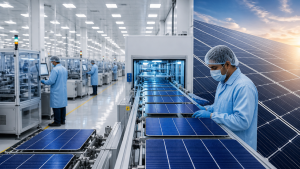
Premier Energies commissioned a 7 GW N-type TOPCon G12R solar cell manufacturing facility at Naidupeta in Andhra Pradesh on 21 September 2026. The plant increased the company’s total solar cell manufacturing capacity to 10.6 GW, which is the highest solar cell capacity in India.
Solar Cell Manufacturing in India
Solar cells convert sunlight into electricity through the photovoltaic effect. N-type TOPCon is a solar cell technology that uses tunnel oxide passivated contact architecture and is used in high-efficiency modules. G12R refers to a large-format wafer and cell size used in modern photovoltaic manufacturing.
Facility Features and Capacity
The facility covers 101 acres, or about 40 hectares, and involved a capital expenditure of ₹3,293 crore. It is designed to produce around 88,000 solar cells per hour. The plant has started trial runs, and commercial output is expected after stabilisation and ramp-up.
The facility is designed for an average solar cell efficiency of about 25.8% after stabilisation. It uses digital manufacturing systems, artificial intelligence, and a Zero Liquid Discharge system for water recycling and reuse.
Company Expansion Plans
Premier Energies plans to invest ₹12,500 crore over three years for capacity expansion. The plan includes backward integration into ingot and wafer production, along with diversification into inverters, transformers, and battery energy storage systems.
As of June 2026, the company had an order book worth ₹150 billion. Cells accounted for 58% of the order book, while modules accounted for 40%.
Important Facts for Exams
- Photovoltaic cells are semiconductor devices that convert solar radiation into direct current electricity.
- TOPCon stands for tunnel oxide passivated contact, a high-efficiency solar cell design.
- Zero Liquid Discharge is a water management system in which wastewater is treated and reused with minimal liquid waste.
- Backward integration in solar manufacturing usually covers ingots, wafers, cells, and modules.
| Related | |
|---|---|