Pakistan–Turkey Drone Deal and Its FPV and Loitering Munition Plans
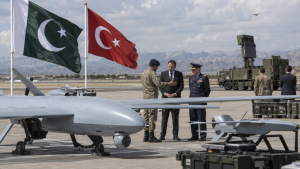
Pakistan’s National Radio and Telecommunication Corporation (NRTC) signed a three-year agreement with Turkish defence firm Pasifik Teknoloji on September 18, 2026, to procure unmanned systems and establish local assembly and manufacturing facilities. The deal’s value is estimated at about USD 100 million, although Pasifik Teknoloji has not announced an official figure. What roles will the different systems serve?
Scope of the Pakistan–Turkey drone agreement
The procurement follows testing and evaluation of the equipment under an earlier framework arrangement in May 2026. The agreement covers aerial drones, loitering munitions and autonomous ground support and observation units. Its listed systems are:
- MERKÜT: 100,000 first-person view (FPV) drones.
- ALPİN: 10 unmanned helicopters.
- DUMRUL: 25 mini-helicopters.
- DELİ: 500 loitering munitions.
- KORGAN: 250 autonomous ground support and observation units.
The package combines platforms with different functions and operating profiles. FPV drones provide an operator with a real-time view from the aircraft, while loitering munitions are designed to search over an area and strike a target. The helicopters and ground units add surveillance, support and observation capabilities to the mix. Local assembly and manufacturing provisions are a distinct feature of the agreement; the stated details do not specify the facilities’ production capacity or timetable.
MERKÜT FPV drones: operator-controlled systems
An FPV drone transmits video from its onboard camera to its operator, who controls the aircraft using that view. This provides a direct perspective during flight and enables operation in dynamic environments. The MERKÜT is the largest item by quantity in the agreement, with 100,000 units planned.
- Range: Up to 8 km.
- Endurance: 20–30 minutes of flight.
- Warhead: Designed to release 1,000 steel balls, each 3 mm in diameter, with a blast radius of up to 20 metres.
- Additional features: Thermal imaging and resistance to electronic warfare measures.
These stated features combine a short operating range and flight duration with a camera-based control method. Thermal imaging is intended to enhance situational awareness, while resistance to electronic warfare measures is identified as a further capability. The agreement specifies the number to be procured but does not set out how the drones will be organised or deployed.
DELİ loitering munitions: search and strike
A loitering munition is designed to remain over a target area while searching for a target, then attack by crashing into it, either autonomously or on command. Unlike an FPV drone, which is controlled through a live camera view, a loitering munition is a disposable weapon system. DELİ is a fixed-wing tactical system.
- Range and airtime: Up to 85 km and 75 minutes, respectively.
- Warhead: 3.1 kg or 3.8 kg, depending on the variant.
- Launch methods: Hand-launching or a catapult system.
- Navigation and coordination: Anti-jamming Global Navigation Satellite System (GNSS) capability and potential swarm functionality.
The DELİ’s stated range and airtime distinguish it from the MERKÜT’s shorter-range, shorter-duration profile. Anti-jamming GNSS capability is intended to support operation where satellite navigation signals are disrupted. Swarm functionality is described as a potential feature, meaning multiple drones could operate cooperatively; it is not presented as a confirmed operational configuration for the Pakistani procurement.
Helicopters and autonomous ground units
The remaining platforms broaden the agreement beyond small aerial systems. ALPİN is an unmanned helicopter intended primarily for surveillance, while DUMRUL is an electric mini-helicopter designed for short-range reconnaissance and strike missions. KORGAN units provide ground-based support for drone operations.
- ALPİN: Has a maximum payload capacity of 200 kg, including fuel; endurance exceeds nine hours, and its service ceiling is 6,400 metres. It can carry out pre-programmed missions autonomously and is equipped with thermal imaging and night-vision technology.
- DUMRUL: Has an endurance of about 120 minutes and a low acoustic signature. It can carry light weaponry and supports FPV control for tactical missions.
- KORGAN: Supports drone launch, landing and battery swapping, and is intended for perimeter defence and observation networks. Its GNSS-independent navigation is designed to support operation in contested environments.
These systems have different stated roles: ALPİN combines long endurance with surveillance equipment, DUMRUL is configured for shorter-range missions, and KORGAN supports the operation and observation of drone networks. Their inclusion means the agreement is not limited to aerial platforms or strike systems.
Defence industrial cooperation
The agreement forms part of broader defence cooperation between Pakistan and Turkey. In 2025, the two countries announced plans for a joint aircraft manufacturing facility intended to produce Turkey’s fifth-generation KAAN fighter jets locally. The drone deal’s provision for assembly and manufacturing in Pakistan adds an industrial element to the procurement, alongside the delivery of unmanned systems. Together, these arrangements indicate cooperation in both defence equipment acquisition and planned local production; the stated details do not establish the scale or completion dates of either manufacturing effort.
| Related | |
|---|---|