New X-Ray Clues from Blazars
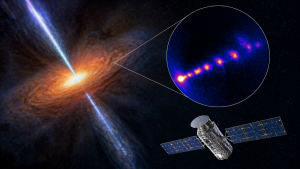
On 25 September 2026, astronomers announced new findings on X-ray emission from blazars, which are active galactic nuclei powered by supermassive black holes. The study was led by the Aryabhatta Research Institute of Observational Sciences (ARIES), Nainital, an autonomous institute under the Department of Science and Technology (DST), India.
Blazars and Active Galactic Nuclei
Blazars are a class of active galactic nuclei in which a relativistic jet points close to the line of sight of the observer. They are among the most luminous persistent sources in the universe and are often studied in the X-ray and gamma-ray bands. TeV blazars are blazars detected at tera-electronvolt energies.
X-Ray Observations and Study Sample
The study was published in The Astrophysical Journal and used data from NASA’s NICER and NuSTAR space telescopes. Researchers Riya Bhowmick and Alok C. Gupta analysed 13 sets of X-ray observations from four TeV blazars: Mrk 421, Mrk 501, PG 1553+113, and PKS 2155-304.
Jet Emission and Accretion Flow
Observations of Mrk 421 and Mrk 501 during moderate to low activity states showed an additional component at lower X-ray energies. This component is linked to radiation from the accretion flow around the black hole when jet emission becomes weaker. The study also recorded a previous similar case for Mrk 421 and a first indication of a comparable contribution in Mrk 501.
Important Facts for Exams
- ARIES is based in Nainital and functions under the Department of Science and Technology.
- NICER stands for Neutron star Interior Composition Explorer.
- NuSTAR stands for Nuclear Spectroscopic Telescope Array.
- Mrk 421, Mrk 501, PG 1553+113, and PKS 2155-304 are all TeV blazars.
Black Hole Physics and High-Energy Astronomy
Blazar studies help in the examination of jet physics, accretion processes, and high-energy radiation near supermassive black holes. X-ray astronomy uses space-based observatories because Earth’s atmosphere absorbs most X-rays.
| Related | |
|---|---|