Key Reproductive, Maternal and Child Health Programmes
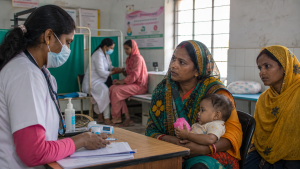
India’s reproductive, maternal and child health programmes focus on reducing preventable deaths, improving nutrition, and strengthening immunization and antenatal care. These interventions combine clinical guidelines, digital tracking, and community-based delivery systems to improve coverage and outcomes across age groups.
NFHS-6 Key Health and Nutrition Indicators
The National Family Health Survey-6 (NFHS-6), covering 2023–24, shows continued improvement in maternal care, child immunization, and nutrition indicators. The data reflects stronger institutional delivery coverage, better antenatal care access, and gains in child health outcomes.
| Parameter | NFHS-5 (2019–2021) | NFHS-6 (2023–24) |
| Institutional Deliveries | 88.6% | 90.6% |
| National Antenatal Care (ANC) Coverage | – | 95.9% |
| First Trimester ANC Registration | – | 76.2% |
| Four or more Antenatal Check-ups | 58.5% | 65.2% |
| Full Immunization (12–23 months) | 83.8% | 87.1% |
| Rotavirus Vaccination Coverage | 36.4% | 85.4% |
| Stunting (children under 5 years) | 35.5% | 29.3% |
| Severe Wasting (children under 5 years) | 7.7% | 5.2% |
| Total Fertility Rate (TFR) | 2.0 | 2.0 |
These figures indicate a steady shift towards institutional care, improved prenatal monitoring, and better child nutrition. The Total Fertility Rate remains at 2.0, which is below the replacement level of 2.1.
Revised Anaemia Mukt Bharat 7x7x7 Strategy
The Anaemia Mukt Bharat (AMB) Abhiyaan remains a key intervention to reduce anaemia among vulnerable populations. Its revised framework moves from the earlier 6x6x6 design to a 7x7x7 strategy, widening both beneficiary coverage and delivery mechanisms.
- Beneficiary expansion: Low birth weight infants aged 0 to 6 months have been added as the seventh beneficiary group.
- Additional intervention: “Eating right” has been introduced as the seventh critical intervention.
- Digital mechanism: Digital tracking has been added as the seventh institutional mechanism.
- Protocol shift: The programme has moved from the T3 framework to T4, meaning Test, Treat, Talk, and Track.
- Follow-up focus: The revised model emphasizes systematic digital monitoring to improve treatment completion and outcomes.
Samagra Shishu Bal Swasthya Karyakram and SUMAN Roadmap
The Samagra Shishu Bal Swasthya Karyakram (SSBSK) is a unified national programme that integrates Home-Based Newborn Care (HBNC) and Home-Based Care for Young Child (HBYC). It is designed to improve neonatal and child survival and covers children up to 36 months of age.
- At-risk newborn care: High-risk or at-risk newborns receive up to nine structured home visits during the first 42 days of life.
- Young child follow-up: At-risk children receive up to eight home visits up to 36 months of age to monitor growth and development.
- Continuum of care: The programme links care from the newborn stage through early childhood at the household level.
The SUMAN Roadmap 2030 (Surakshit Matritva Aashwasan) provides the long-term strategy for reducing maternal mortality. It aims to bring India’s Maternal Mortality Ratio (MMR) below 70 deaths per 1,00,000 live births by 2030, in line with the Sustainable Development Goals.
Digital and Infrastructure Initiatives
Several digital platforms and quality-improvement programmes support the delivery of maternal and child health services. These initiatives focus on registration, monitoring, service quality, and emergency transport.
- U-WIN Portal: The national digital immunization platform tracks vaccination schedules for children and pregnant women. As of March 18, 2026, it had registered 11.87 crore children and 3.96 crore pregnant women.
- LaQshya Initiative: The Labour Room Quality Improvement Initiative aims to improve care in labour rooms and maternity operation theatres. As of February 2026, 1,244 Labour Rooms and 917 Maternity Operation Theatres had achieved national quality certification.
- Pradhan Mantri Surakshit Matritva Abhiyaan (PMSMA): This scheme provides free, comprehensive, and quality antenatal care on the 9th of every month. It has recorded over 7.91 crore free antenatal check-ups and detected more than 1.24 crore high-risk pregnancies.
- National Ambulance Services: Updated operational guidelines standardize infrastructure, staffing, emergency medical equipment, and digital integration for medical transport.
Why These Programmes Matter
- Maternal care: Institutional deliveries, antenatal registration, and regular check-ups reduce risks during pregnancy and childbirth.
- Child survival: Home-based newborn and child care helps detect complications early and supports growth monitoring.
- Anaemia control: The revised AMB strategy broadens beneficiary coverage and adds digital follow-up.
- Immunization tracking: U-WIN strengthens vaccination coverage through digital registration and scheduling.
- Quality assurance: LaQshya improves standards in labour rooms and maternity theatres.
- Safe motherhood: PMSMA ensures regular high-quality antenatal screening for pregnant women.
- Long-term target: SUMAN Roadmap 2030 aligns maternal health goals with the SDG framework.
Key Prelims Takeaways
- NFHS-6: Conducted in 2023–24; institutional deliveries rose to 90.6% and TFR remained at 2.0.
- Child nutrition: Stunting fell to 29.3% and severe wasting to 5.2% in NFHS-6.
- Rotavirus coverage: Increased sharply to 85.4% in NFHS-6.
- AMB 7x7x7: Adds low birth weight infants, “eating right,” and digital tracking.
- T4 framework: Expands Test, Treat, Talk into Test, Treat, Talk, and Track.
- SSBSK: Provides nine home visits for at-risk newborns in 42 days and eight visits for at-risk children up to 36 months.
- SUMAN target: Aims to reduce MMR below 70 per 1,00,000 live births by 2030.
| Related | |
|---|---|