Minor Forest Produce and Tribal Value Chains in India
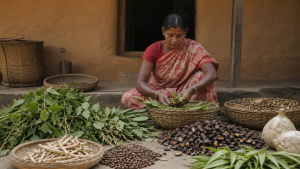
Minor Forest Produce (MFP) supports forest-based livelihoods, food security and cultural practices among tribal and other forest-dwelling communities. Fair access to these resources, better market returns and sustainable use are central to strengthening tribal value chains.
Meaning and Importance of Minor Forest Produce
MFP broadly refers to non-timber forest products of plant origin. It includes bamboo, brushwood, stumps, canes, tussar and cocoons, as well as honey, wax, lac, tendu or kendu leaves, medicinal plants, roots, tubers, wild fruits and flowers. These products provide food, materials for household use and income to forest-dependent families. MFP is gathered from forests and may be sold in raw form or processed into products. Its importance therefore extends beyond trade: access to produce can support subsistence, while collection and sale contribute to livelihoods. The value chain includes gathering, primary processing, storage, packaging and marketing. Returns to gatherers depend in part on access to markets and the scope for local value addition.
- Livelihoods: MFP is an important source of income for tribal households and other forest-dwelling communities.
- Product range: It includes both commonly traded products, such as honey and lac, and a diverse range of forest foods and plant materials.
- Value chain: Processing and marketing can raise the value retained by communities compared with selling produce only in raw form.
Rights and Institutional Framework
The Scheduled Tribes and Other Traditional Forest Dwellers (Recognition of Forest Rights) Act, 2006, commonly called the Forest Rights Act (FRA), recognises forest rights of eligible forest-dwelling Scheduled Tribes and other traditional forest dwellers. These include individual forest rights and community forest resource rights. The Act recognises ownership of, and the right to access, collect, use and dispose of, MFP. The Panchayats (Extension to Scheduled Areas) Act, 1996 (PESA), extends provisions relating to Panchayats to Scheduled Areas. It gives Gram Sabhas powers that include ownership of MFP and the ability to manage it. Together, FRA and PESA provide a basis for community control over forest produce and local decision-making in Scheduled Areas.
- Gram Sabha role: Community institutions can participate in managing and marketing MFP, supporting local control over resources.
- Ministry of Tribal Affairs: The Ministry is the nodal ministry for policy, planning and development programmes for Scheduled Tribes, including MFP-related initiatives.
- TRIFED: Established in 1987 under the Ministry of Tribal Affairs, the Tribal Cooperative Marketing Development Federation of India is the national-level apex organisation for promoting the marketing and value addition of tribal products.
Minimum Support Price Scheme
The Government of India launched the “Mechanism for Marketing of Minor Forest Produce (MFP) through Minimum Support Price (MSP) and Development of Value Chain for MFP” scheme in 2013–14. It seeks to provide a safety net for gatherers by ensuring a minimum price for covered produce and reducing their exposure to exploitative market practices. The scheme also links price support with the development of value chains.
- Nodal agency: TRIFED is the nodal agency for implementing the scheme.
- Coverage: The scheme began with 10 selected MFP items and has since expanded to cover a larger number of items.
- Price setting: States determine MSPs for different items, which are then centrally approved.
- Procurement: State Designated Agencies, including State Tribal Development Corporations and Forest Departments, have a role in procuring MFP at the declared MSP.
Value Addition and Tribal Enterprise
Value addition can improve returns to gatherers by shifting some processing and marketing activity closer to the communities that collect MFP. Rather than selling only raw produce, communities can process, package and market finished products. This can support local enterprise while strengthening the link between forest-based livelihoods and markets. Sustainable resource use remains important: livelihoods and value chains depend on the continued availability of forest produce. Van Dhan Yojana, launched in 2018 as a component of the MSP for MFP scheme, promotes Van Dhan Vikas Kendras (VDVKs). These centres act as common facility hubs for procurement, primary processing, value addition, packaging and marketing. Each VDVK is organised as a cluster of 15 tribal Self Help Groups (SHGs), with up to 20 tribal gatherers in each SHG.
- Product diversification: Processing can turn MFP into organic foods, herbal products, handicrafts, natural dyes and forest foods such as honey, jams and pickles.
- Market access: TRIFED’s Tribes India outlets and e-commerce platforms seek to connect tribal products with buyers and reduce reliance on middlemen.
- Branding: Packaging and branding can help communicate the natural and cultural identity of products to consumers.
- Local benefits: Building processing and marketing capacity can help communities retain a greater share of value generated along the chain.
Key Prelims Takeaways
- MFP comprises non-timber forest products of plant origin, including bamboo, honey, lac and medicinal plants.
- The FRA, 2006, recognises rights over MFP, including ownership and the right to collect, use and dispose of it.
- PESA, 1996, provides for Gram Sabha ownership of MFP in Scheduled Areas.
- TRIFED was established in 1987 under the Ministry of Tribal Affairs.
- The MFP MSP and value-chain scheme was launched in 2013–14; TRIFED is its nodal agency.
- Van Dhan Yojana, launched in 2018, promotes VDVKs for processing, value addition and marketing.
Recent Context
On October 25, 2026, Shabari Naturals, a Maharashtra government initiative, received the G-Mark – Global Design Award for packaging inspired by Warli, Gond and Chitrakathi art. The award permits the initiative to display the G-Mark logo on its packaging; it had previously received the India Design Mark.
| Related | |
|---|---|