Matsya-6000 500-Metre Trial Dive Expected in Early 2027
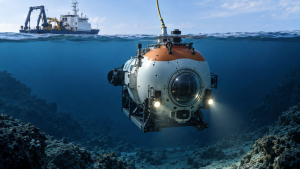
India’s deep-ocean submersible Matsya-6000 is expected to undertake a 500-metre trial dive in January-February 2027, Ministry of Earth Sciences Secretary Srinivasa Kumar Tummala said on 13 November 2026. The trial is part of preparations for a crewed descent to 6,000 metres under the Samudrayaan Project.
Submersible design and trials
The National Institute of Ocean Technology is developing Matsya-6000 under India’s Deep Ocean Mission. Its 2.1-metre-diameter spherical hull is designed to carry three people and support 12-hour missions, with a 96-hour emergency backup. The initial 500-metre human trials will use a steel sphere. A 2.1-metre titanium alloy personnel sphere, being developed with the Indian Space Research Organisation, is intended for the 6,000-metre mission. NIOT pilots Ramesh Raju and Jatinder Pal Singh are training for the mission; a scientist may also join the crew.
Testing and mission objectives
Wet tests on Matsya were conducted during the week of 6-12 November 2026. Earlier wet testing was completed at Kattupalli Port near Chennai by 17 September 2026. The mission aims to explore ocean biodiversity, conduct surveys and assess mineral resources in line with India’s Blue Economy vision.
Important Facts for Exams
- Pressure hull: Matsya-6000’s planned personnel sphere is titanium alloy, 80 mm thick and 2.1 metres in diameter, designed to withstand 600 bar.
- Nodule minerals: A major Deep Ocean Mission target is polymetallic nodules, containing manganese, nickel, cobalt, copper and iron hydroxide.
- Depth-zone classification: Marine depth zones commonly place the abyssal zone at roughly 4,000–6,000 metres, while the hadal zone generally refers to depths below 6,000 metres.
- International seabed governance: Under UNCLOS, mineral resources on the international seabed beyond national jurisdiction fall under the International Seabed Authority, which grants exploration contracts.
| Related | |
|---|---|