Major Metallic and Non‑Metallic Minerals of India
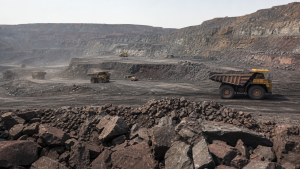
India has a varied geological base that supports a wide range of metallic and non-metallic minerals. These minerals are vital for steel, cement, aluminium, power, chemicals, construction and several high-tech industries.
Classification and Major Deposits of Metallic Minerals
Metallic minerals contain metals in raw form and are broadly grouped into ferrous minerals, which contain iron, and non-ferrous minerals, which do not. India is especially rich in ferrous minerals such as iron ore and manganese, while important non-ferrous minerals include bauxite and copper.
- Iron ore: It is the backbone of the metallurgical sector and accounts for nearly 70% of the total mineral production value under the Mineral Conservation and Development Rules (MCDR). India recorded production of 289 million metric tonnes (MMT) in FY 2024-25, making it the fourth-largest producer globally.
- Major iron ore belts: Barabil-Koira valley in Odisha, Bailadila range in Chhattisgarh, and the Bellary-Hospet region in Karnataka are the principal deposit areas.
- Manganese: It is essential for steelmaking and is mainly found in the Dharwar system of Karnataka, the Balaghat belt of Madhya Pradesh, and the Bhandara-Nagpur belt of Maharashtra.
- Bauxite: This is the chief ore of aluminium. India is the second-largest producer of aluminium globally. Important reserves are located in the Panchpatmali deposits in Koraput (Odisha), the Amarkantak plateau (Madhya Pradesh), and the Maikal hills (Chhattisgarh).
- Copper: India ranks among the top 10 global producers of refined copper despite limited ore deposits. The main producing regions are the Malanjkhand belt in Madhya Pradesh, the Khetri belt in Rajasthan, and the Singhbhum district in Jharkhand.
Classification and Major Deposits of Non-Metallic Minerals
Non-metallic minerals do not contain metals and are widely used in industry, construction and chemical manufacturing. Among them, limestone, mica, gypsum and dolomite are especially important in India.
- Limestone: It is the principal raw material for cement production and is widely distributed across the country. India is the third-largest producer of lime globally.
- Major limestone deposits: Key occurrences are found in the Cuddapah basin of Andhra Pradesh, Rajasthan, Madhya Pradesh and Gujarat.
- Mica: India was traditionally a leading exporter of sheet mica, with important belts in the Nellore belt of Andhra Pradesh, the Koderma-Hazaribagh belt in Jharkhand, and the Ajmer region in Rajasthan.
- Gypsum: It is extensively mined in Rajasthan, particularly in Bikaner and Jaisalmer districts, for use in cement and fertilizer industries.
- Dolomite: Used as a flux in the iron and steel industry, dolomite is mainly extracted from Chhattisgarh, Odisha and Andhra Pradesh.
Regulatory and Fiscal Framework for Mining
The mining sector is governed by the Mines and Minerals (Development and Regulation) (MMDR) Act, 1957. Recent amendments have reshaped fiscal and regulatory powers relating to mineral rights and mineral-bearing lands.
- MMDR Amendment Act, 2026: Formally notified on August 22, 2026, it aims to create a uniform national fiscal framework by limiting state-level taxes and levies on mineral rights and mineral-bearing lands.
- Union control: The amendment modifies Section 2 of the 1957 Act to bring mineral-bearing lands under the regulatory control of the Union government.
- Section 9D: It prohibits State governments from imposing any tax, cess or levy on mineral rights or mineral-bearing lands unless this is in accordance with conditions prescribed by the Centre.
- Past dues: The amendment gives retrospective relief to leaseholders by invalidating unpaid or unrecovered state taxes, cesses or levies imposed before the amendment.
- Judicial backdrop: The law responds to the Supreme Court’s July 2024 ruling in Mineral Area Development Authority v. Steel Authority of India, where the Court held that royalty is not a tax and upheld the States’ power to tax mineral rights and mineral-bearing lands.
National Critical Mineral Mission and Auction Regimes
The National Critical Mineral Mission (NCMM) is designed to secure domestic supply chains for green energy, space, defence and electronics. It also supports exploration, auctioning and recycling of strategic minerals.
- Mission period: The NCMM runs from FY 2024-25 to FY 2030-31.
- Financial outlay: It has an approved outlay of ₹16,300 crore and an expected public sector investment of ₹18,000 crore.
- Exploration target: The mission aims to support 1,200 domestic exploration projects through the Geological Survey of India (GSI) by 2030-31.
- Production target: It seeks domestic production of at least 15 critical minerals.
- Overseas assets: The mission also targets acquisition of 50 mining assets abroad.
- Recycling incentive: NCMM includes a ₹1,500 crore incentive scheme for mineral recycling to reduce import dependence.
- Auction streamlining: The Mineral (Auction) Second Amendment Rules, 2026, notified on March 30, 2026, introduced a digital Online Unified Mining Portal, automated Letters of Intent, insurance surety bonds as alternatives to bank guarantees, and simplified upfront payments.
Key Prelims Takeaways
- Iron ore: India is the fourth-largest producer globally; FY 2024-25 output reached 289 MMT.
- Aluminium: India is the second-largest producer globally, with bauxite as the chief ore.
- Lime: India is the third-largest producer globally, with limestone as the key raw material.
- Copper: India is among the top 10 global producers of refined copper.
- High-value mineral: Iron ore remains the most valuable mineral under the MCDR regime, accounting for nearly 70% of total production value.
- MMDR framework: The MMDR Amendment Act, 2026 inserts Section 9D to restrict state taxation on mineral-bearing lands.
- NCMM focus: The mission covers exploration, production, recycling and overseas acquisition of critical minerals.
| Related | |
|---|---|