Madras High Court Allows Witnesses to Testify by Video Link
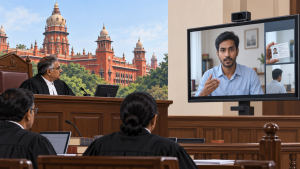
On August 12, 2026, the Madras High Court issued its Video Conferencing Rules, 2026, through an administrative order. The rules allow witnesses in trial courts to testify by video link from suitable locations, including their homes or workplaces, with the court’s permission.
Scope of the Rules
The rules permit video conferencing at all stages of judicial or disciplinary proceedings, including hearings, evidence recording and the examination of parties, witnesses or accused persons. They expand access beyond designated locations such as offices of superintendents of police and government hospitals.
Verification and Applicability
In criminal proceedings, the advocate or party concerned must confirm the location, the witness’s willingness and the availability of facilities. Identity must be verified using valid proof submitted electronically or shown on camera when directed by the court. The rules apply to courts and tribunals in Tamil Nadu and the Union Territory of Puducherry under the Madras High Court’s supervisory jurisdiction, except tribunals established under Acts of Parliament.
Important Facts for Exams
- Appellate reach: The Madras High Court has appellate jurisdiction over Tamil Nadu and the Union Territory of Puducherry.
- Video testimony precedent: In State of Maharashtra v. Dr Praful B. Desai (2003), the Supreme Court held that video-conferenced testimony can satisfy the CrPC requirement of evidence being taken in the accused’s presence.
- High Court rule-making framework: The Supreme Court’s 2020 model Video Conferencing Rules invited High Courts to adopt the framework with suitable modifications, rather than requiring identical local procedures.
- Accused’s electronic presence: Section 308 of the Bharatiya Nagarik Suraksha Sanhita treats an accused’s presence through audio-video electronic means as presence when evidence is recorded.
| Related | |
|---|---|