LHS 1140b Shows Helium-Rich Rocky Exoplanet Atmosphere
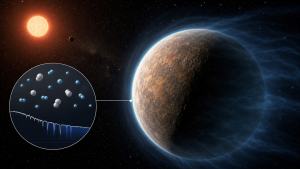
LHS 1140b is a rocky exoplanet about 48 to 49 light-years away in the constellation Cetus. It has a mass of 5.6 Earth masses and a radius of 1.73 Earth radii. Researchers have detected helium escaping from its atmosphere, which places it among the few rocky, temperate exoplanets with observational evidence of an atmosphere in the habitable zone of its star.
LHS 1140b and Super-Earths
LHS 1140b is classified as a super-Earth, a term used for planets larger than Earth but smaller than ice giants such as Neptune. The planet orbits a red dwarf star, and its location in the habitable zone means it receives conditions that can allow liquid water to exist on the surface, depending on atmospheric composition and pressure.
Helium Detection and Atmospheric Escape
The detection of helium was made using the Warm Infrared Echelle Spectrograph on the Magellan Clay Telescope at Las Campanas Observatory in Chile. Helium escape is a common tracer of atmospheric loss in exoplanet studies because helium can extend into the upper atmosphere and absorb infrared light at specific wavelengths. Observations in 2024 showed a clear helium signal from LHS 1140b, while 2025 observations did not detect escaping helium. This pattern indicates that atmospheric escape can vary over time on rocky exoplanets. The presence of helium supports the existence of a helium-rich upper atmosphere, while models also allow for heavier volatile species such as water at lower altitudes.
Habitable Zone and Astrobiology
The habitable zone is the orbital region around a star where a planet can maintain liquid water on its surface under suitable atmospheric conditions. LHS 1140b is considered a target for astrobiology studies because it is a rocky planet in this zone and has retained an atmosphere for at least 3.1 billion years, which is about three-quarters of Earth’s age. LHS 1140c, another rocky planet in the same system, orbits closer to the star and receives about five times more radiation than LHS 1140b. No atmosphere has been detected on LHS 1140c.
Important Facts for Exams
- Science is a peer-reviewed journal that publishes original research across natural sciences.
- Super-Earths are exoplanets with masses greater than Earth’s but below those of Uranus and Neptune.
- The habitable zone is also called the Goldilocks zone in astronomy.
- James Webb Space Telescope and Hubble Space Telescope are used in exoplanet atmosphere studies.
Exoplanet Research Context
Atmospheric studies of rocky exoplanets help scientists compare planetary evolution across different star systems. Helium detection is one of the methods used to study atmospheric retention, escape processes, and the possible presence of other gases on planets outside the Solar System.
| Related | |
|---|---|