Ladakh Declares 23 Heritage Sites as Protected Monuments
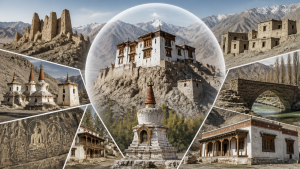
On 30 July 2026, the Ladakh administration declared 23 heritage sites across the Union Territory as Protected Monuments under the Jammu and Kashmir Ancient Monuments Preservation Act. The list includes petroglyph clusters, rock carvings, ancient caves, monasteries, forts, palaces, and inscriptions from different parts of Ladakh.
Protected Monuments in Indian Heritage Law
A protected monument is a site, structure, or object that receives legal protection under a heritage law for preservation and regulated conservation. In India, such protection is used for monuments of archaeological, historical, or artistic value, and it can restrict construction, encroachment, and unauthorised alteration in the notified area.
Types of Heritage Sites Notified in Ladakh
The 23 notified sites in Ladakh include rock art, religious structures, defensive architecture, and habitation remains. Petroglyphs are rock engravings made by prehistoric or early historic communities, while gompas are Buddhist monasteries found widely in the Trans-Himalayan region. Specific sites in the list include the Petroglyph Site at Sharnos, the Maitreya Buddha Rock Carving at Shey near Sindhu Ghat, Tingmosgang Fort, Ancient Caves at Saspol, Stongday Gonpa, Sumoor Fort, and rock inscriptions at Yourbaltak in Kargil. These sites represent archaeological and cultural material from different periods of Ladakh’s history.
Legal and Conservation Provisions
The declaration allows the administration to regulate activities around the notified sites and to prevent encroachments. It also permits planned conservation work, scientific documentation, and structural restoration for monuments that have faced natural decay or neglect. The Jammu and Kashmir Ancient Monuments Preservation Act is a heritage protection law used for the preservation of monuments in the region. Such laws generally provide for notification, maintenance, and control of activities near protected heritage assets.
Important Facts for Exams
- Ladakh became a Union Territory on 31 October 2019 after the reorganisation of Jammu and Kashmir.
- Petroglyphs are rock carvings or engravings and are important sources for prehistoric and early historic studies.
- Gompa is the Tibetan term commonly used for a Buddhist monastery in Ladakh and other Himalayan regions.
- Rock inscriptions and cave sites are often used by archaeologists to study trade routes, religion, and settlement patterns.
Protected monuments in India are notified for legal preservation, regulated access, and conservation under heritage laws. Ladakh contains Buddhist monasteries, fort remains, rock art, and cave sites that form part of its archaeological record.
| Related | |
|---|---|