Karnataka Unveils Marine Biotechnology Policy
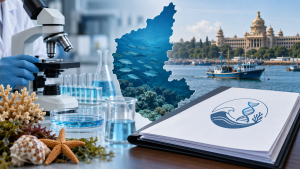
D.K. Shivakumar announced the Karnataka Marine Biotechnology Policy on 17 November 2026 at the 29th Bengaluru Tech Summit. The state government approved the five-year policy, covering 2026–2031, on 18–19 September 2026.
Investment and proposed institution
The policy proposes an outlay of ₹120 crore. It aims to expand Karnataka’s blue bioeconomy from about USD 2 billion to USD 6–8 billion by 2031. It also proposes establishing the Karnataka Institute of Marine Biotechnology and Blue Economy (KIMBE) at the Government Fisheries College.
Research and employment plans
The policy proposes laboratories, a biobank and incubation centres in Udupi, along with dedicated Marine Biotechnology Zones. Its focus areas include fisheries, seaweed, marine biomaterials, biomanufacturing and sustainable aquaculture. The initiative is projected to create about 2,500 high-value technical jobs and 7,500 coastal enterprise and livelihood opportunities.
Important Facts for Exams
- Seaweed groups: Seaweed includes red, green and brown multicellular algal groups; they lack a common multicellular ancestor and form a polyphyletic group.
- Seaweed hydrocolloids: Alginate, agar and carrageenan are seaweed-derived hydrocolloids used in food for properties including gelling, water retention and emulsification.
- Mariculture distinction: Mariculture is aquaculture in seawater habitats and lagoons, whereas freshwater aquaculture takes place in freshwater environments.
| Related | |
|---|---|