Japan Scrambles Jets After Suspected Russian Airspace Incursion
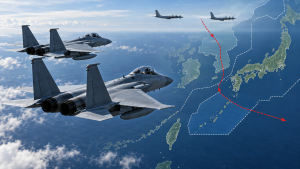
Japan scrambled fighter jets on Tuesday, 17 November 2026, after two suspected Russian aircraft entered its airspace near Okinoshima, off Fukuoka, shortly after 4 am local time. The first aircraft entered at about 4:07 am and remained for roughly three minutes.
Japan’s response and aircraft route
Japan Air Self-Defense Force jets were sent to warn the aircraft. Chief Cabinet Secretary Minoru Kihara called the violation a grave infringement of sovereignty and “completely unacceptable”. Tokyo lodged a “very stern protest” with Moscow through diplomatic channels and demanded measures to prevent a recurrence.
The aircraft flew through the Tsushima Strait, passed between Yonaguni Island in Okinawa Prefecture and Taiwan, and continued towards the Pacific Ocean. The supplied accounts differ on the previous confirmed Russian airspace incursion: one identifies September 2024, while another describes a 2024 incursion as the first since 2019.
South Korea’s air-defence response
On the same day, South Korea deployed fighter jets and conducted tactical manoeuvres after several Russian military aircraft entered its Korea Air Defence Identification Zone (KADIZ) over the East Sea, also known as the Sea of Japan. South Korean forces detected the aircraft before they entered the zone; they did not enter South Korean sovereign airspace. An air defence identification zone is distinct from sovereign airspace, and advance notification is generally expected but is not legally required.
Important Facts for Exams
- ADIZ legal status: An air defence identification zone is declared unilaterally and is neither defined in an international treaty nor recognised by an international body.
- ADIZ reach: An air defence identification zone can extend beyond a country’s territory, allowing more time to respond to potentially hostile aircraft.
- Radar coverage: The JASDF’s Basic Air Defense Ground Environment combines radar installations and air-defence direction centres in an integrated nationwide network.
- Regional missile control: Each of the JASDF’s four regional headquarters controls the JASDF and Ground Self-Defense Force surface-to-air missile units in its area.
| Related | |
|---|---|