India’s Wheat Area Set for Steepest Decline in 26 Years
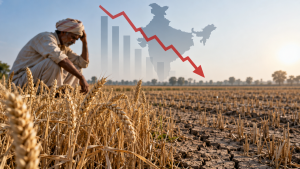
India’s wheat area in the 2026/27 season is forecast to fall by about 6% from the 2025/26 record of 33.6 million hectares, Reuters reported on November 20, 2026. The projected 31.58 million hectares would be the lowest in four years and the steepest decline since 2000/01.
Sowing and rainfall
By November 13, wheat had been sown on about 5 million hectares, 15.3% less than a year earlier. Monsoon rainfall from June to September was the lowest in more than a decade; Punjab, Rajasthan, Madhya Pradesh and Maharashtra received rainfall reported as much as 41% below average. Industry officials said some farmers were switching to less water-intensive chickpeas and rapeseed, while wheat acreage was expected to remain largely steady in irrigated Punjab and Haryana. In Maharashtra’s Jalna district, farmer Vilas Bhutekar said he switched to chickpeas because water was insufficient to sow and irrigate wheat.
Minimum support price
The government raised wheat’s minimum support price by 1% to ₹2,610 per 100 kg. Reuters reported that this was the smallest increase since 2002/03.
Important Facts for Exams
- Awn water use: Wheat awns photosynthesise more efficiently than leaves in water use, and are more common in varieties grown in hot, drought-prone regions.
- MSP decision-making: The Commission for Agricultural Costs and Prices recommends crop support prices, but the Cabinet Committee on Economic Affairs makes the final decision on MSPs.
- Critical irrigation stage: For irrigated wheat, crown-root initiation about 20–25 days after sowing is a critical irrigation stage; moisture stress can impair root establishment and tillering.
- Wheat ploidy: Bread wheat is hexaploid, with A, B and D genomes; durum wheat is tetraploid and is used chiefly to make pasta.
| Related | |
|---|---|