Indian Navy Receives Indigenous Military-Grade ROVs
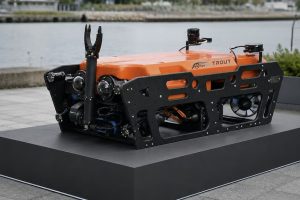
On 7 October 2026, Kochi-based company EyeROV delivered two TROUT underwater Remotely Operated Vehicle (ROV) systems to the Indian Navy. The delivery is the first of five systems ordered by the Navy and marks the delivery of India’s first indigenously built military-grade ROV. The vehicle is rated to operate at depths of up to 300 metres.
Remotely Operated Vehicles
A Remotely Operated Vehicle is an uncrewed underwater vehicle controlled by an operator, commonly through a tether connecting it to a surface control station. ROVs can carry cameras, lights, sensors and manipulator arms for underwater observation and tasks. An autonomous underwater vehicle (AUV), by contrast, can navigate underwater without continuous direct control through a tether.
The EyeROV TROUT is designed for underwater inspection, surveillance and reconnaissance, search and recovery, detection, and robotic intervention. Its stated operational features include manoeuvrability, navigation, endurance, operator control and operation in strong underwater currents and poor visibility.
iDEX and Indigenous Defence Development
The TROUT was developed under the iDEX DISC 7 SPRINT Challenge. Innovations for Defence Excellence (iDEX) is a Ministry of Defence initiative that supports the development of defence and aerospace technologies by innovators and enterprises. SPRINT refers to the Indian Navy’s initiative to promote indigenous development of technologies for naval use.
The TROUT underwent field trials and system-level validation. The trials covered manoeuvrability, deep-diving capability, performance in currents, detection, navigation, endurance and operator control. EyeROV had earlier secured a ₹47 crore Indian Navy contract to supply advanced underwater ROVs.
Military Qualification and Uses
The system was processed through the quality assurance framework of the Directorate of Quality Assurance (Naval), or DQA(N). It was engineered to meet applicable military standards, including Environmental Stress Screening (ESS) under DQA(N) policies. ESS checks whether equipment can withstand environmental stresses associated with its intended operating conditions.
Underwater ROVs are used in naval and subsea operations, including inspection of underwater infrastructure, port and harbour security, maritime security, and search and recovery. Their cameras and sensors can provide operators with visual or instrument-based information from underwater locations.
Important Facts for Exams
- An ROV is controlled remotely, while an AUV can operate autonomously.
- iDEX stands for Innovations for Defence Excellence.
- DQA(N) stands for Directorate of Quality Assurance (Naval).
- The EyeROV TROUT has a stated maximum operating depth of 300 metres.
The Indian Navy’s order covers five EyeROV TROUT systems, of which two were delivered on 7 October 2026. The TROUT was developed under the iDEX DISC 7 SPRINT Challenge.
| Related | |
|---|---|