India Plans Five Greenfield Shipbuilding Clusters
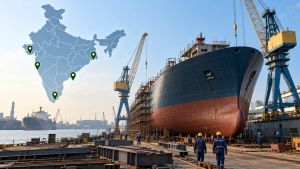
On 16 November 2026, Union Minister for Ports, Shipping and Waterways Sarbananda Sonowal announced a plan to attract nearly $10 billion in investment for five greenfield shipbuilding clusters. All five locations have received in-principle approval.
Proposed locations and targets
The clusters are proposed at Dugarajapatnam in Andhra Pradesh, Kuchhadi in Gujarat, Dighi in Maharashtra, Kendrapara in Odisha and Thoothukudi in Tamil Nadu. India aims to become one of the world’s top 10 shipbuilding nations by 2030 and rank among the top five by 2047, with annual capacity of about 4.5 million gross tonnes by 2047.
Funding, infrastructure and industry participation
The plan is supported by an approximately $8 billion maritime financial package approved in September 2025, which includes financial assistance schemes, a Maritime Development Fund and a Shipbuilding Development Scheme. Clusters will receive full capital support for common maritime and internal infrastructure through Special Purpose Vehicles jointly owned by the Central and respective state governments. A Ministry amendment on 28 October 2026 cut the deadline for these SPVs to submit final approval proposals from 24 months to 12 months. In April 2026, HD Korea Shipbuilding & Offshore Engineering and Indian partners outlined plans for a Thoothukudi shipyard with envisaged annual capacity of 2.5 million gross tonnage. The India Shipbuilding Investment Conclave 2026 in New Delhi drew HD Hyundai, Samsung Heavy Industries, Hanwha Ocean, Maersk and CMA CGM. Sonowal also launched Naukosh, a Directorate General of Maritime Administration portal for policies, approvals and investment opportunities in shipbuilding and ship repair. Ten international delegations were scheduled to inspect proposed sites on 17 November.
Important Facts for Exams
- Block construction: Modern shipyards assemble vessels from prefabricated sections: large hull or superstructure blocks are moved to a dock or slipway and lifted into position.
- Pre-installed systems: Shipyard teams can fit pipes, electrical cables and equipment inside blocks before assembly, reducing work in hard-to-reach parts of the hull.
- Laser-hybrid welding: Laser-hybrid welding combines a deep-penetrating laser beam with a trailing MIG filler process, enabling faster welding with less distortion from heat.
| Related | |
|---|---|