India Discovers ₹5.25 Per Unit RTC Renewable Tariff
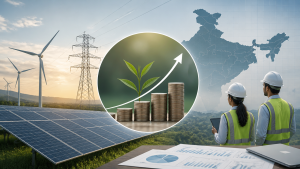
India discovered a record-low tariff of ₹5.25 per unit in round-the-clock (RTC) renewable energy bidding on 7 August 2026. The tariff was announced in New Delhi at the 7th CII International Energy Conference and Exhibition. The auction results were linked to Firm and Dispatchable Renewable Energy projects and RTC procurement by the Solar Energy Corporation of India.
Round-the-Clock Renewable Energy
RTC renewable energy refers to power supply designed for continuous availability across all time blocks of the day. Such projects combine solar power, wind power, and energy storage systems to provide dispatchable electricity. The bidding framework is used for power purchase contracts that require assured supply rather than only generation during sunlight hours.
SECI Auction Structure
The Solar Energy Corporation of India conducted a 1,000 MW Firm and Dispatchable Renewable Energy auction under the SECI-FDRE-RTC-V tender. Five developers won capacity at ₹5.25 per kilowatt-hour, including Kengeri Prime Solar Power, Resolven Four Energy, Hero Solar Energy, EMIF II Holding, and Purvah Green Power. Hexa Climate and Juniper Green Energy secured additional capacity at ₹5.26 per unit.
Technical Bidding Conditions
MNRE tender conditions required developers to maintain a minimum of 90% assured power delivery in every time block during peak hours. The guidelines also required 50% to 60% power supply during solar hours and at least 70% during the remaining periods. These conditions are linked to hybrid generation and storage-based supply models used in renewable energy procurement.
Important Facts for Exams
- Round-the-clock renewable energy is a hybrid power model that uses solar, wind, and energy storage systems.
- The Solar Energy Corporation of India is a central public sector enterprise under the Ministry of New and Renewable Energy.
- Firm and Dispatchable Renewable Energy projects are designed to provide scheduled and reliable electricity supply.
- Energy storage systems are used in renewable projects to balance generation and demand across different time blocks.
Related Static GK
India uses competitive bidding for renewable power procurement under central and state-level frameworks. Green hydrogen is produced using electricity from renewable sources and is linked with low-carbon industrial and transport applications. Data centres require continuous electricity supply, which makes dispatchable renewable power relevant for their operations.
Current Renewable Energy Context
India has expanded solar, wind, hybrid, and storage-based power procurement in recent years. RTC and FDRE tenders are part of the broader shift towards reliable renewable electricity in the national power market.
| Related | |
|---|---|