India and Austria Strengthen Ties with Key Agreements
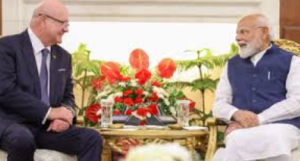
Prime Minister Narendra Modi held bilateral talks with Austrian Chancellor Christian Stocker in New Delhi on April 16, 2026, marking a significant step in strengthening India–Austria relations. The visit, Stocker’s first official trip to India, comes after four decades of such high-level engagement and signals renewed momentum in diplomatic and economic cooperation between the two nations.
Focus on Trade, Technology and Investment
The discussions centred on enhancing cooperation across key sectors, including trade, investment, technology, renewable energy, and cultural exchanges. Both leaders emphasised leveraging Austria’s technological expertise alongside India’s scale and growth potential. The talks also highlighted opportunities in emerging domains such as semiconductors, quantum technology, and biotechnology, aiming to build resilient global supply chains.
MoUs and Institutional Collaborations
Several Memoranda of Understanding (MoUs) were exchanged following the talks, reflecting concrete steps towards deeper collaboration. Notably, an agreement between IIT Delhi and Austria’s Montan University was highlighted as a model for academic and research cooperation. The two sides also announced initiatives to boost mobility, including expansion in the nursing sector and the launch of an India–Austria Working Holiday Programme to facilitate youth exchange.
Shared Views on Global Challenges
Both leaders discussed pressing global issues, including conflicts in Ukraine and West Asia. They reiterated their shared stance that lasting solutions cannot emerge through military conflict and stressed the need for peaceful resolution and reform of global institutions. Counter-terrorism cooperation and commitment to global stability were also key elements of the dialogue.
Important Facts for Exams
- Austria is a Central European country and a member of the European Union.
- India–EU Free Trade Agreement negotiations have strategic economic significance.
- MoUs are non-binding agreements that outline cooperation between entities.
- Rajghat in New Delhi is the memorial of Mahatma Gandhi.
Diplomatic Significance and Future Outlook
The visit underscores growing India–Europe engagement, particularly after the India–EU Free Trade Agreement milestone. Chancellor Stocker’s delegation, including senior ministers and business leaders, reflects a strong intent to deepen economic ties. With increased collaboration in innovation, research, and workforce mobility, the partnership is expected to contribute to long-term bilateral growth and global cooperation.
| Related | |
|---|---|