Important Ocean and Polar Science Initiatives in India
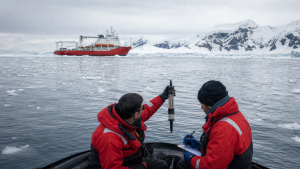
India’s ocean and polar science ecosystem is driven by the Ministry of Earth Sciences through major schemes, research stations, observatories, and deep-sea missions. These initiatives support climate research, blue economy goals, marine biodiversity studies, and sustainable exploration of polar and ocean resources.
Prithvi Vigyan (PRITHVI) Scheme
The Prithvi Vigyan (PRITHVI) scheme is an umbrella initiative of the Ministry of Earth Sciences. It integrates several specialized sub-schemes to study the earth system, oceans, and polar regions.
- Integrated focus: The PRITHVI scheme consolidates key research fields like climate, oceanography, polar sciences, and seismology.
- Main objective: It aims to improve understanding of global climate feedback loops and marine resources.
- Key components: Two critical components of this umbrella program are the PACER and O-SMART schemes.
Polar Science and Cryosphere Research (PACER)
The National Centre for Polar and Ocean Research (NCPOR) in Goa implements the PACER scheme. It conducts scientific studies across the Arctic, Antarctic, Southern Ocean, and Himalayan regions.
- Antarctic Program: This component manages annual expeditions to the South Pole. It maintains permanent bases and supports long-term research in atmospheric sciences and glaciology.
- Indian Arctic Program: This program manages scientific operations in the high latitudes. It monitors Svalbard and surrounding waters.
- Southern Ocean Program: It focuses on biogeochemical processes and ocean circulation near Antarctica.
- Cryosphere and Climate Program: This program studies snow, ice, and glaciers to understand global warming patterns.
India’s Antarctic Bases
- Dakshin Gangotri: Established in 1983 as India’s first permanent base. It is currently abandoned due to ice submergence and serves as a supply depot.
- Maitri: Built in 1989 in the Schirmacher Oasis. It conducts research in biology, earth sciences, and meteorology.
- Bharati: Active since 2012 in the Larsemann Hills. This station is constructed with durable materials to withstand extreme sub-zero temperatures.
India’s Arctic and Himalayan Presence
- Himadri Base: Established in 2008 at Ny-Ålesund, Svalbard, Norway. It serves as India’s primary Arctic research facility.
- IndARC Observatory: Deployed in 2014 in Kongsfjorden, Svalbard. It is India’s first multi-sensor moored sub-surface observatory in the Arctic.
- HIMANSH Research Station: Located in Spiti, Himachal Pradesh. Established in 2016, it conducts glaciological research in the high-altitude Himalayan region.
Deep Ocean Mission (DOM)
The Deep Ocean Mission, also referred to as the “Samudra Manthan Mission,” is a five-year program launched in 2021. It carries a budget of USD 4,077 crore. The mission aims to develop indigenous technologies for deep-sea exploration and resource extraction.
Six Thematic Pillars of the Deep Ocean Mission
- Technologies for Deep-Sea Mining and Manned Submersibles: This pillar focuses on developing the Samudrayaan project and the MATSYA 6000 manned submersible.
- Ocean Climate Change Advisory Services: This component develops advanced models to project future ocean-climate variables.
- Technological Innovations for Deep-Sea Biodiversity: This team studies marine organisms for biotechnology and pharmaceutical purposes.
- Deep-Ocean Survey and Exploration: This work involves locating metal deposits along the Indian Ocean ridges.
- Energy and Freshwater from the Ocean: This program explores Ocean Thermal Energy Conversion (OTEC) and seawater desalination.
- Advanced Marine Station for Ocean Biology: This center builds regional research capabilities and guides biotechnology enterprises.
Key Facts and Recent Explorations
- Polymetallic Nodules: The International Seabed Authority allocated a 75,000 square kilometer site in the Central Indian Ocean Basin to India in 2016. This site contains estimated reserves of 380 million tonnes of polymetallic nodules. These nodules hold copper, manganese, nickel, and cobalt.
- Samudrayaan Project: India is developing MATSYA 6000 to carry three human crew members to a depth of 6,000 meters. The submersible has a 72-hour operating endurance.
- Deep Sea Accomplishment: Indian aquanauts completed a test dive to a depth of 5,000 meters in August 2025. Researchers also collected over 100 kilograms of cobalt-rich polymetallic nodules from the Andaman Sea at a depth of 1,173 meters.
Ocean Services, Modelling, Applications, Resources and Technology (O-SMART)
O-SMART is a multidisciplinary umbrella scheme that supports India’s Blue Economy goals. The Union Cabinet approved its continuation for the 2021-2026 period with an allocation of USD 2,177 crore.
Sub-Schemes under O-SMART
The program comprises seven sub-schemes implemented by specialized institutes under the MoES:
- Ocean Technology: It focuses on designing deep-sea systems and marine energy solutions.
- Ocean Modelling and Advisory Services (OMAS): This program generates daily ocean state forecasts and issues warnings for potential storm surges or tsunamis.
- Ocean Observation Network (OON): It collects real-time ocean data through moored buoys, wave riders, and drifters.
- Ocean Non-Living Resources: This sub-scheme focuses on mapping deep-sea minerals like gas hydrates and polymetallic sulphides.
- Marine Living Resources and Ecology (MLRE): It studies the health of marine species and ecosystems within India’s Exclusive Economic Zone (EEZ).
- Coastal Research: This program monitors shoreline erosion and tracks seawater pollution levels.
- Operation and Maintenance of Research Vessels: This component funds the management of the research fleet.
Key Implementing Institutions of O-SMART
- INCOIS (Hyderabad): The Indian National Centre for Ocean Information Services provides ocean advisories to coastal communities and fishermen.
- NIOT (Chennai): The National Institute of Ocean Technology develops underwater tools, submersibles, and marine energy systems.
- CMLRE (Kochi): The Centre for Marine Living Resources and Ecology handles the management of living marine resources.
- NCCR (Chennai): The National Centre for Coastal Research focuses on coastal pollution monitoring and shoreline management.
Key Research Infrastructure
India maintains a fleet of oceanographic and coastal vessels to support marine exploration.
| Vessel Name | Type of Vessel | Primary Functions |
| ORV Sagar Kanya | Oceanographic Vessel | Flagship ship for biological, chemical, and physical oceanography in the Indian Ocean. |
| BTV Sagar Nidhi | Technology Demonstration | Equipped with dynamic positioning systems to test underwater submersibles and mining systems. |
| RV Sagar Manjusha | Coastal Research | Conducts shallow water surveys and monitors marine pollution near the Indian coast. |
| RV Sagar Anveshika | Coastal Research | Measures coastal environmental parameters and assesses marine living resources. |
| RV Sagar Tara | Coastal Research | Deployed for seawater sampling and atmospheric observations along the coast. |
Current BRICS Ocean and Polar Science Cooperation
The 8th Meeting of the BRICS Working Group on Ocean and Polar Science and Technology is currently underway in Goa, India. The three-day meeting began on August 12, 2026, and is scheduled to conclude on August 14, 2026. NCPOR is hosting the meeting as part of India’s 2026 BRICS Presidency.
- BRICS membership: BRICS is an expanded intergovernmental grouping of 11 member countries: Brazil, China, Egypt, Ethiopia, India, Indonesia, Iran, Russia, Saudi Arabia, South Africa, and the United Arab Emirates.
- Working Group: The BRICS OPST Working Group was established in 2018 to facilitate scientific cooperation, knowledge exchange, capacity building, and collaborative activities in marine and polar research.
- Chair for 2026: Dr. Thamban Meloth, Director of NCPOR, is the Chair of the Working Group for 2026 and presided over the Goa meeting.
- Core agenda: The meeting focuses on short-term and medium-term goals to transition from bilateral arrangements to integrated multilateral research programs, including shared use of polar research infrastructure.
- India and OPST: This is the second time India is hosting the OPST working group meeting. India previously hosted the third BRICS OPST meeting during its 2020 presidency.
- Key keynote: Dr. M. Rajeevan, Vice Chancellor of Atria University and former Secretary of the Ministry of Earth Sciences, delivered the keynote lecture on “India’s Blue Economy Initiatives.”
Trivia on Polar and Ocean Science
- Ny-Ålesund Committee: India became a member of the Ny-Ålesund Science Managers Committee in 2008 to coordinate Arctic research.
- Arctic Council status: India has held Observer Status in the Arctic Council since 2013.
- Indian Antarctic Act: The Indian Antarctic Act of 2022 provides a domestic regulatory framework to protect the Antarctic environment and regulate scientific expeditions.
- UN Ocean Decade: The United Nations declared 2021–2030 as the “Decade of Ocean Science for Sustainable Development,” aligning with India’s Deep Ocean Mission objectives.
Rare Facts for Prelims
- Schirmacher Oasis: Maitri is located on a rare ice-free rocky plateau in East Antarctica, which makes it suitable for year-round scientific operations.
- Larsemann Hills: Bharati is built in one of the few Antarctic coastal regions that remain relatively accessible for logistics and station support.
- Ny-Ålesund: Himadri operates in one of the world’s northernmost permanent settlements used for international Arctic science.
- IndARC: The observatory was deployed in a fjord environment, allowing long-term monitoring of ocean-atmosphere interactions in the Arctic.
- OTEC relevance: Ocean Thermal Energy Conversion works best in tropical seas where warm surface water and cold deep water create a large temperature gradient.
- Polymetallic nodules: These are often called “potato-sized” mineral concretions and are among the most important deep-sea mineral resources under study.
| Related | |
|---|---|