Hera Reaches DART’s Asteroid Impact Site
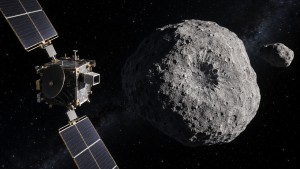
The European Space Agency’s Hera spacecraft arrived at the Didymos binary asteroid system, including its moonlet Dimorphos, in early November 2026. Hera will investigate the site where NASA’s Double Asteroid Redirection Test (DART) spacecraft struck Dimorphos on 26 September 2022.
Hera’s observations of Didymos and Dimorphos
Hera’s Asteroid Framing Camera captured Didymos and Dimorphos as separate objects on 18 October 2026, from about 1,280 kilometres away. Braking manoeuvres on 15 and 22 October slowed the spacecraft’s approach and enabled it to enter orbit around the system. On 5 November, Hera obtained a close-up image of Didymos from about 60 kilometres away, showing boulders, craters and an equatorial ridge.
Investigating the DART impact
Hera will map the asteroids, measure Dimorphos’s mass and examine its interior using onboard instruments and the Milani and Juventas CubeSats. The mission will investigate why DART changed Dimorphos’s orbit around Didymos by 33 minutes, a greater shift than initially predicted, to improve understanding of the kinetic-impact planetary-defence method. Detailed images of Dimorphos are expected on 25 November 2026. Hera launched on 7 October 2024 aboard a SpaceX Falcon 9 and arrived about a month ahead of its original schedule.
Important Facts for Exams
- Impact physics: Hera’s kinetic-impact assessment will relate momentum transfer to asteroid density, porosity, and surface and internal structure.
- Juventas radar: Juventas carries JuRa, a 50–70 MHz radar with 10–15 metre resolution designed to probe an asteroid’s inner layers.
- Milani spectroscopy: Milani will collect spectral data to study both asteroids’ surface composition and detect dust in the surrounding space.
| Related | |
|---|---|