DRDO Conducts Maiden Live Jump of Advanced High-Altitude Parachute
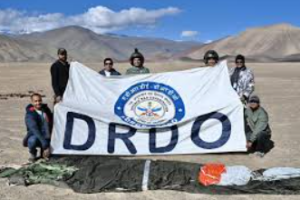
The Defence Research and Development Organisation (DRDO) conducted the maiden live jump of its Advanced High-Altitude Parachute (AHAP) on 6 October 2026. The trial took place at the Mudh Drop Zone near Nyoma in Ladakh, with the jump executed from 16,000 feet above mean sea level (AMSL).
Live-Jump Trial
The AHAP deployed at 15,500 feet AMSL, and the parachutist landed at the Mudh Drop Zone, which is at an altitude of 13,700 feet. The trial tested the parachute for military operations in high-altitude terrain. The system has an operational altitude range of up to 18,000 feet.
Design and Manufacture
The Aerial Delivery Research and Development Establishment (ADRDE), a DRDO laboratory based in Agra, designed and developed the AHAP. The Ordnance Parachute Factory (OPF) in Kanpur manufactured the system. Defence Minister Rajnath Singh congratulated DRDO and the associated teams after the live jump and referred to the test in the context of Aatmanirbhar Bharat.
Parachute Systems and Altitude Measurement
The AHAP is a static-line parachute designed for the mass drop of paratroopers. A static line connects a parachute to an aircraft and initiates deployment as the parachutist exits. The AHAP supports different deployment modes for aerial delivery. AMSL measures an altitude relative to mean sea level, rather than the elevation of the immediate ground surface.
Important Facts for Exams
- DRDO is India’s Defence Research and Development Organisation under the Ministry of Defence.
- ADRDE is located in Agra and undertakes research and development in aerial delivery systems.
- A static-line system initiates parachute deployment through a line attached to the aircraft.
- AMSL is a vertical reference used to state elevation relative to mean sea level.
The AHAP was developed by ADRDE and manufactured by OPF for high-altitude paratrooper deployment. Its stated operational altitude range extends up to 18,000 feet.
| Related | |
|---|---|