China’s Long March 7A Rocket Explodes After Launch
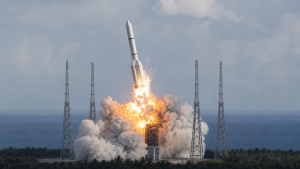
The Long March 7A is a 60-metre-tall Chinese launch vehicle used for satellite missions. On 10 August 2026, it lifted off from the Wenchang Space Launch Site on Hainan Island with the ChinaSat-4B communications satellite and suffered an in-flight anomaly about 85 seconds after launch.
Long March 7A Rocket
The Long March 7A belongs to China’s Long March rocket family, which includes multiple orbital launch vehicles developed for space missions. The rocket uses YF-100 engines, a liquid-fuel engine type also associated with other Chinese launch systems.
ChinaSat-4B Satellite
ChinaSat-4B is a communications satellite designed for global radio, television, and telecommunications services. The payload was lost when the launch vehicle broke up at low altitude and low velocity over the South China Sea.
Launch Failure and Mission Record
The launch failure occurred during the first-stage flight phase, and the rocket exploded in a fireball with thick black smoke. Flight records show that this was the second failure in 18 Long March 7A missions, with the first failure occurring on its maiden flight in March 2020.
Important Facts for Exams
- The Wenchang Space Launch Site is located on Hainan Island in southern China.
- The Long March 7A is an unmanned launch vehicle used for satellite deployment.
- YF-100 engines are used in several Chinese rocket families, including the Long March 5, Long March 6, and Long March 8.
- Xinhua is China’s official state news agency.
Investigation and Technical Context
Chinese authorities confirmed that an investigation into the cause of the anomaly was underway on 11 August 2026. The failure involved a rocket family that shares engine technology with other active Chinese launch vehicles.
| Related | |
|---|---|