Cabinet Approves BHAVYA Rasayan Scheme
The Union Cabinet approved the Bharat Audyogik Vikas Yojana Rasayan (BHAVYA Rasayan) scheme on 24 July 2026. The scheme provides ₹3,030 crore for three dedicated chemical parks in India and will run from Financial Year 2026-27 to FY 2030-31.
BHAVYA Rasayan Scheme
BHAVYA stands for Bharat Audyogik Vikas Yojana Rasayan. The scheme is designed for the chemical sector and covers common infrastructure facilities, basic utilities, and administrative expenditure. Of the total outlay, ₹3,000 crore is earmarked for infrastructure development inside the parks. The remaining ₹30 crore is allocated for administrative expenses.
Chemical Park Framework
Each chemical park will be developed by a state government through a challenge-based selection process. Each park must have at least 2,000 acres, or 8 sq. km., of contiguous and encumbrance-free land. The Central government will provide financial assistance of up to ₹1,000 crore for each park. This assistance is linked to a minimum contribution of ₹500 crore by the concerned state government. 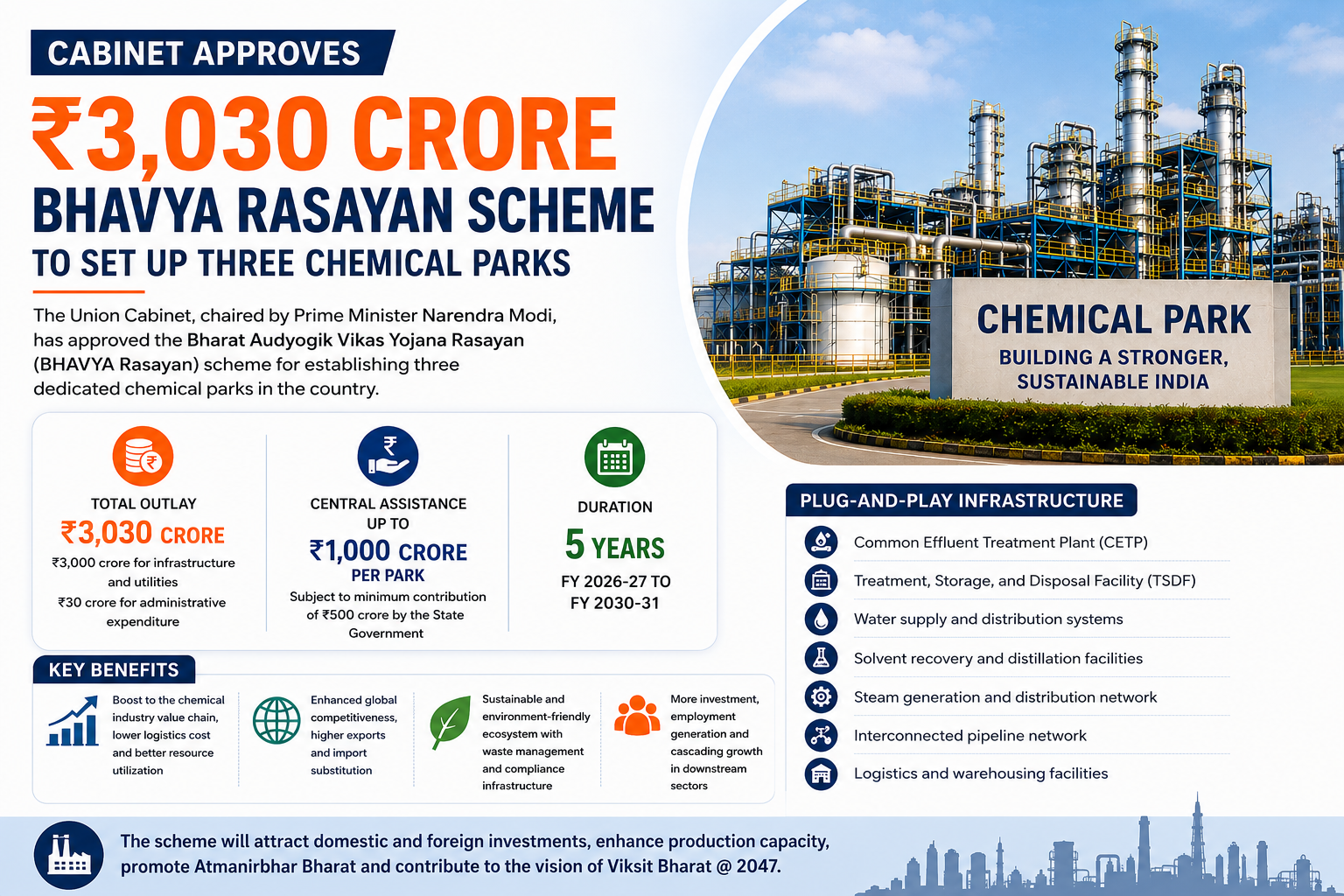
Infrastructure Components
The parks will follow a plug-and-play model for industrial use. The planned facilities include Common Effluent Treatment Plants (CETPs), Treatment, Storage and Disposal Facilities (TSDFs), water supply systems, and logistics infrastructure. CETPs are shared plants used for treating industrial effluents. TSDFs are facilities used for the treatment, storage, and disposal of hazardous waste.
Important Facts for Exams
- The chemical sector in India includes fertilisers, petrochemicals, dyes, and speciality chemicals.
- Common infrastructure in industrial parks often includes power supply, water supply, roads, and waste management systems.
- Challenge-based selection is a method in which states compete for project approval on specified criteria.
- Contiguous land means land that is joined together without gaps.
Industrial Policy Context
Chemical parks are industrial clusters created to support manufacturing units within a shared ecosystem. Such parks are used in India for sector-specific industrial development and logistics planning. The chemical industry is one of the major segments of India’s manufacturing base and includes both bulk chemicals and speciality chemicals.
| Related | |
|---|---|