Black-Necked Crane Population in Ladakh Rises to 108
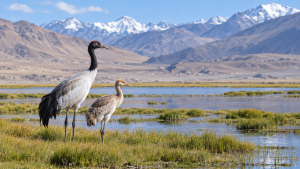
Ladakh recorded 108 black-necked cranes in its 2026 breeding-season survey, up nearly 25% from 87 in 2025. The count comprises 86 adults and 22 juveniles. The black-necked crane is Ladakh’s state bird.
Survey and breeding sites
Chushul recorded 16 birds, while Tsokar and Kargyam recorded 15 each and Korzok 14. Together, the four sites accounted for 60 birds, nearly 56% of the total surveyed across the Changthang Range. Adult numbers grew at an average annual rate of about 12.9% between 2021 and 2025. Juveniles increased from 17 in 2025; hatchling counts were nine in 2021 and seven in 2022.
Conservation efforts
Lieutenant Governor VK Saxena credited the Environment Protection Force, including ex-servicemen, and local communities for protecting nests, eggs and hatchlings from free-ranging dogs. In early 2026, the Ladakh administration held its first black-necked crane festival to promote habitat conservation and community participation.
Important Facts for Exams
- Wetland nesting: Black-necked cranes usually nest on pre-existing mud islands within large, shallow wetlands; bar-headed geese may share these nesting sites.
- Egg-laying season: Black-necked cranes lay eggs mainly in May and June, with a clutch of one or two eggs.
- Breeding habitat: Black-necked cranes breed in alpine meadows, lakeside and riverine marshes, and river valleys, mainly on the high-altitude Tibetan Plateau.
| Related | |
|---|---|