Airborne Warning and Control System (AWACS)
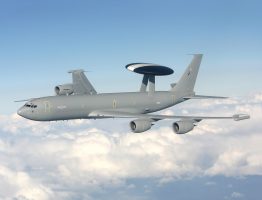
An Airborne Warning and Control System (AWACS) refers to a sophisticated airborne radar system designed to provide all-weather surveillance, command, control, and communications to military forces. It acts as an airborne radar picket, detecting and tracking aircraft, missiles, and ships at long ranges, while also directing fighter and attack aircraft during combat operations. AWACS aircraft serve as critical components of modern air defence and combat operations, enhancing situational awareness and force coordination.
Background and Development
The origins of AWACS can be traced back to the Second World War, when early radar systems were first employed for detecting enemy aircraft. During the 1950s and 1960s, advances in radar technology and miniaturisation allowed radar systems to be mounted on aircraft, providing mobile and wide-ranging detection capabilities.
The United States pioneered the concept with the EC-121 Warning Star, developed by Lockheed in the 1950s. However, it was the Boeing E-3 Sentry, introduced in the 1970s, that became the defining example of a modern AWACS platform. The E-3 incorporated a powerful pulse-Doppler radar housed within a distinctive rotating dome mounted above the fuselage.
Following the success of the E-3, several other nations developed their own variants, including the Russian Beriev A-50, the British E-3D Sentry AEW1, and the Indian DRDO AEW&CS based on the Embraer ERJ-145 platform. Each adaptation reflected specific national defence needs and technological capabilities.
Technical Features
AWACS aircraft are distinguished by their radar systems, communications suites, and onboard command centres that allow real-time analysis and coordination. The key features typically include:
- Radar Dome (Rotodome): A large rotating dish, usually mounted above the fuselage, that provides 360-degree coverage. The E-3 Sentry’s radar can detect aircraft more than 400 kilometres away.
- Pulse-Doppler Radar: Enables detection of low-flying aircraft even against ground clutter, using the Doppler effect to distinguish moving targets.
- Command and Control Systems: Onboard computer systems process radar data and distribute it to command networks or directly to intercepting aircraft.
- Data Links: Secure communication channels allow the AWACS to share real-time data with ground, sea, and air units.
- Crew Stations: Typically, an AWACS carries a crew of 10–20, including radar operators, controllers, and communications specialists.
Modern AWACS systems may also integrate electronic warfare (EW) capabilities, allowing them to jam enemy radar or communications systems, and Identification Friend or Foe (IFF) systems to distinguish between allied and hostile aircraft.
Strategic Roles and Applications
AWACS serve as force multipliers within air forces, providing an aerial command post that enhances the operational effectiveness of combat units. Their primary applications include:
- Airspace Surveillance: Continuous monitoring of large airspace regions, detecting and tracking potential threats.
- Airborne Command and Control: Directing fighter intercepts and managing air battle coordination.
- Early Warning: Providing advance notice of hostile aircraft or missile launches, allowing defensive measures to be deployed.
- Search and Rescue Operations: Assisting in locating aircraft or vessels in distress.
- Maritime Surveillance: In some configurations, AWACS can track ships and submarines.
These functions make AWACS indispensable for both defensive and offensive operations, as they enable the control of large-scale air engagements and ensure superior situational awareness.
Global AWACS Systems
Various nations have developed or acquired AWACS platforms to meet strategic requirements:
- United States: Boeing E-3 Sentry (USAF), and E-7A Wedgetail, based on the Boeing 737 platform.
- United Kingdom: E-3D Sentry AEW1 (Royal Air Force), being replaced by the E-7 Wedgetail.
- Russia: Beriev A-50 and its upgraded variant A-100 Premier.
- China: KJ-2000 and KJ-500 airborne early warning aircraft.
- India: DRDO AEW&CS (Netra) and planned AWACS India on Airbus A321 platform.
- NATO: Operates a fleet of E-3A aircraft based at Geilenkirchen Air Base, Germany.
These systems differ in radar technology, endurance, and mission capability but share the common goal of ensuring air superiority and integrated defence control.
Advantages and Limitations
Advantages:
- Provides comprehensive, long-range radar coverage far exceeding that of ground-based systems.
- Enhances coordination between various branches of armed forces.
- Offers mobility and flexibility to cover large or remote regions.
- Acts as an airborne communications hub, especially useful in network-centric warfare.
Limitations:
- High acquisition and operational costs due to complex systems and crew requirements.
- Vulnerability to enemy air defences or electronic attacks if unescorted.
- Dependence on aerial refuelling for extended missions.
- Requires secure and advanced data networks for maximum effectiveness.
Despite these limitations, AWACS aircraft remain a central element of air command structures due to their unique ability to integrate information and direct operations across wide theatres.
Modern Trends and Future Developments
Recent advancements have focused on miniaturisation, digital signal processing, and artificial intelligence integration. The development of the E-7A Wedgetail marks a shift towards lighter, more cost-efficient platforms using active electronically scanned array (AESA) radar technology.
Furthermore, research into unmanned aerial vehicles (UAVs) equipped with AWACS-like sensors aims to reduce risk to human crews and operational costs. Enhanced data fusion technologies also allow integration of satellite and ground-based radar inputs, creating comprehensive multi-domain situational awareness.