Astronomers Directly Observe Giant Star Engulfing Its Companion
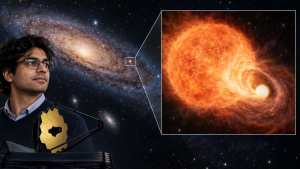
Astronomers have directly observed a giant star engulfing its smaller companion, a process known as common envelope evolution, for the first time. The event, designated AT 2025abao and nicknamed “Bao”, occurred in the Andromeda galaxy, about 2.5 million light-years from Earth. The findings were published in Nature on 18 November 2026.
A seven-year stellar event
The team was led by Viraj Karambelkar, a NASA Hubble Fellow at Columbia University. The companion began spiralling into the larger star’s outer layers in 2018 and moved towards its core over about seven years. The puffy supergiant was around seven times the Sun’s mass and 350 times its radius; its companion had about 0.7 solar masses.
Researchers first noticed unusual brightening in 2023. A powerful eruption followed on 17 October 2025, with the system reportedly reaching a brightness about a million times that of the Sun. The James Webb Space Telescope observed it 47 days after the eruption’s peak, in December 2025. Estimates indicate that 0.1–0.2 solar masses of material were expelled. Further monitoring is needed to confirm that the stars merged.
Important Facts for Exams
- Orbital drag: Drag inside the common-envelope gas removes energy from the orbit, bringing the two objects closer and increasing their orbital speeds.
- Possible outcomes: The phase may end by ejecting the envelope and leaving a much tighter binary, or by the two stars merging into one.
- Runaway mass transfer: Roche-lobe overflow can become a runaway as the orbit shrinks and mass transfer accelerates; an overwhelmed receiving star may become engulfed with its companion.
| Related | |
|---|---|