15-Year Programme Saves World’s Heaviest Insect
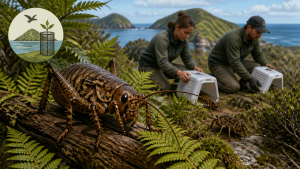
A 15-year conservation breeding programme has led to the release of approximately 11,000 wētāpunga (Deinacrida heteracantha) into the wild in New Zealand. The wētāpunga is New Zealand’s heaviest insect and is among the heaviest insect species in the world.
Taxonomy and distribution
Wētāpunga is a giant wētā, a group of large insects native to New Zealand. Its scientific name is Deinacrida heteracantha. The species is managed through captive breeding and releases at selected wild sites, including predator-free islands and mainland reserves.
Captive breeding and translocations
Butterfly Creek and Auckland Zoo led the breeding programme, with support from New Zealand’s Department of Conservation. The programme’s releases comprised 45 translocations to 10 sites north of Auckland. These sites included eight predator-free islands and two mainland reserves. A translocation is the deliberate movement of organisms to establish or reinforce a population at another location.
The programme’s results were detailed in a report published in the New Zealand Journal of Zoology. Dr Chris Green, an honorary researcher at the Department of Conservation, co-authored the report, which was released on 2 October 2026.
Conservation status and wild populations
The wētāpunga’s conservation classification changed from “Threatened Nationally Endangered” in 2004 to “Threatened Nationally Increasing” in 2022. Self-sustaining populations have been established on Motuora and Tiritiri Matangi. At least four to five generations have been born in the wild on these two islands without constant human intervention.
Important Facts for Exams
- Deinacrida heteracantha is the scientific name of the wētāpunga.
- Butterfly Creek and Auckland Zoo led the wētāpunga breeding programme, with Department of Conservation support.
- Motuora and Tiritiri Matangi have wild wētāpunga populations with at least four to five generations born in the wild.
- Methods developed for wētāpunga conservation are also informing work on the Māhoenui giant wētā and native stag beetles.
The programme released approximately 11,000 wētāpunga through 45 translocations to 10 sites. The Māhoenui giant wētā and native stag beetles are other New Zealand species receiving conservation attention.
| Related | |
|---|---|