Wildfires Threaten Ancient Cave Paintings in Maros-Pangkep
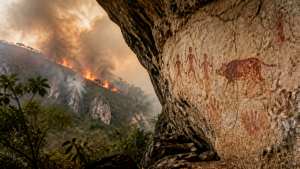
Wildfires in South Sulawesi, Indonesia, have burned more than 270 hectares of the Maros-Pangkep national park between 30 September and 18 October 2026. The fires came within 800 metres of caves containing prehistoric paintings, some dated to more than 67,000 years ago. Heat and smoke can damage the artworks even when flames do not reach the cave walls.
Prehistoric Art in Sulawesi
A cave painting in Maros-Pangkep depicts human-like figures interacting with a pig and has been dated to at least 51,200 years old. Researchers from Griffith University dated a reddish hand stencil in a cave on Muna Island, off Sulawesi, to at least 67,800 years old. The dates place these works among the oldest known examples of cave art.
The caves occur in a karst landscape of limestone formations. The surrounding national park is also designated as a UNESCO Global Geopark, a designation for a unified geographical area containing sites of international geological significance. The park contains both geological features and archaeological sites.
Wildfire Conditions and Risks to Cave Art
Indonesia is experiencing its most intense forest and land fires since 2015. A severe El Niño has brought high temperatures and reduced rainfall, leaving forests and peatland vulnerable to fire. Fires have affected several Indonesian islands, including Sulawesi.
Firefighter Muhammad Ikfar said fires burned near the Maros-Pangkep site for more than a week earlier in October. Dry conditions and an absence of rain persisted as firefighters worked to extinguish fires in other parts of the park on 22 and 23 October. Archaeologist Basran Burhan described heat-driven temperature changes as a risk to the paintings and said smoke can deposit soot over them, making the images blurred and difficult to identify.
Conservation and Geographical Context
Maros-Pangkep is in South Sulawesi, on the Indonesian island of Sulawesi. Muna Island lies off Sulawesi and contains a separate cave-art site. The reported fire damage covers part of the national park and does not establish that the caves or paintings themselves were burned.
Important Facts for Exams
- Sulawesi is an island in Indonesia, and South Sulawesi is one of its provinces.
- El Niño is a recurring climate pattern involving warmer-than-average sea-surface temperatures in the central and eastern equatorial Pacific.
- Karst landscapes commonly develop in soluble rocks such as limestone.
- The Muna Island hand stencil has been dated to at least 67,800 years old.
The Maros-Pangkep park contains limestone caves and prehistoric rock art. More than 270 hectares of the park burned between 30 September and 18 October 2026.
| Related | |
|---|---|