Vulcan Rocket Failure Destroys 40 Amazon Leo Satellites
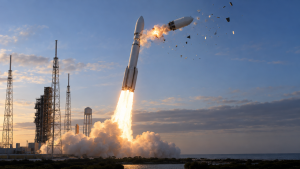
A United Launch Alliance (ULA) Vulcan rocket suffered an anomaly about 10 minutes after liftoff on 15 November 2026, destroying all 40 Amazon Leo internet satellites aboard. It launched from Space Launch Complex 41 at Cape Canaveral Space Force Station, Florida. The cause is unknown, and ULA has begun an investigation.
Mission failure and launch history
The anomaly occurred during the Centaur upper stage’s burn, and the rocket failed to deliver its payload to orbit. It was ULA’s first total mission failure since the company was formed in 2006 as a joint venture of Boeing and Lockheed Martin.
This was the Vulcan’s fifth flight and its first in nine months. It was also the first of 38 Vulcan launches purchased by Amazon for its Leo broadband constellation, formerly known as Project Kuiper.
Earlier Vulcan flights experienced solid rocket booster nozzle malfunctions in October 2024 and February 2026. The boosters reportedly performed normally on this flight after corrective measures. The launch had been delayed from 13 and 14 November because of issues including a power interruption and a network communication problem.
Important Facts for Exams
- Two-stage architecture: Vulcan Centaur is a two-stage-to-orbit launcher, with the Vulcan first stage below a Centaur V upper stage.
- Restartable upper stage: Centaur can restart its engines and combine long coasting phases with multiple burns for complex orbital insertions.
- BE-4 propulsion cycle: Vulcan's first stage uses two Blue Origin BE-4 engines, burning liquefied natural gas and liquid oxygen through an oxygen-rich staged-combustion cycle.
- Configurable solid boosters: Vulcan can use up to six Northrop Grumman GEM 63XL solid rocket motors, with booster count tailored to payload and trajectory requirements.
| Related | |
|---|---|