Vijayanagara-era inscription in Kannada with Tulu words found in Udupi district
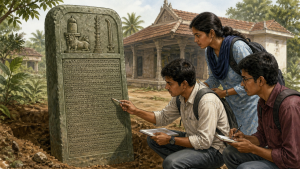
A stone inscription attributed to the Vijayanagara Empire has been found at Dasand Bakimaru, near Jumadi Temple in Kedinje, Belman village, Karkala taluk, Udupi district. Students from Shirva’s M.S.R.S. College identified it and brought it to Professor T. Murugeshi’s attention.
Inscription and historical details
The inscription is in the Kannada language and script, with words in the Tulu language. Carved on greenish soapstone, it measures 46.5 centimetres by 23 centimetres; its lower rectangular panel contains 34 lines. The upper panel depicts a Shiva lingam, a cow, a lamp pillar and a sword associated with Tulu Nadu’s Daivaradhane.
The text names Harihara II and records administrative and land-grant details concerning Barakur and Nandalike. It describes a Brahmadeya grant to two recipients, with a yearly rice provision for a Brahmin who recited the Puranas. The inscription’s date is inconsistent: it gives Shaka 1039, but Professor Murugeshi says it should be Shaka 1309, corresponding to 1387 CE.
Important Facts for Exams
- Tax-free grant: A Brahmadeya was a tax-free land gift to Brahmanas, providing context for the inscription’s recorded grant.
- Grant scale: Brahmadeya grants could comprise an individual plot or an entire village, with recipients becoming landowners or land-controllers.
- Tulu scripts: Tulu has historically been written in both Tigalari and Kannada scripts; Tigalari was especially used for religious manuscripts in coastal Karnataka.
- Barkur's medieval role: Barkur was a major medieval coastal centre and served as the capital of the Alupa dynasty before Vijayanagara's dominance in the region.
| Related | |
|---|---|