Though not very useful from the point of view of a connected political history of South India, the Sangam literature portrays the social and economic conditions of its time with remarkable vividness. Comment. (UPSC 2013)
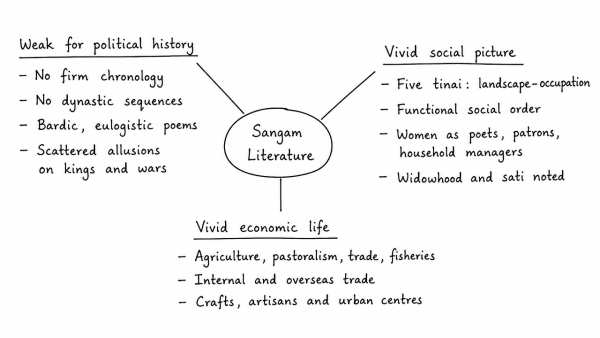
Sangam literature is weak for a continuous political history because it lacks firm chronology, dynastic sequences and systematic narration; its bardic, eulogistic poems record kings and wars only in scattered allusions.
Social life
It vividly presents early Tamil society through the five tinai, linking landscape with occupation—hills, pastoral tracts, farms, coasts and arid zones. The texts reveal a functional social order of rulers, priests, landholders and workers rather than a rigid varna system. Women appear as poets, patrons and managers of household life, though widowhood and sati are also noted.
Economic life
They describe paddy cultivation, irrigation, fishing, pearl diving, weaving, metalwork and vibrant market exchange. References to ports and trade with Yavanas show a monetised, commercially active and outward-looking economy. Thus, despite limited political value, Sangam literature is an exceptionally vivid source for the social and economic history of early South India.