In many ways, Lord Dalhousie was the founder of modern India. Elaborate. (UPSC 2013)
Lord Dalhousie was a key architect of colonial India’s modern administrative and infrastructural order. Though his rule served British interests, many of his measures created lasting institutional foundations.
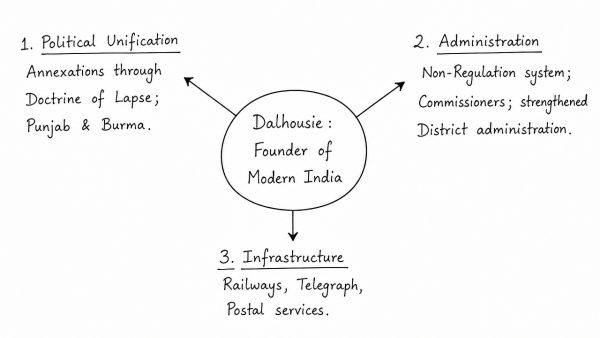
- Political unification: By annexing Satara, Jhansi, Nagpur and Awadh through the Doctrine of Lapse and by conquering Punjab and Lower Burma, he brought large parts of India under a more centralised rule.
- Administration: His Non-Regulation system strengthened executive control through commissioners, shaping later district administration and the role of the Collector.
- Infrastructure: He laid the basis of railways, telegraph, modern postal services and a Public Works Department, improving communication, transport and public works.
- Education and reform: He implemented Wood’s Despatch, leading to a graded education system and the universities of Calcutta, Bombay and Madras.
However, these changes were meant to consolidate colonial control and exploit resources. Still, in administration, connectivity and institution-building, Dalhousie deeply influenced the framework of modern India.
Originally written on
August 28, 2026
and last modified on
August 28, 2026.