Critically discuss the objectives of the Bhoodan and Gramdan movements initiated by Acharya Vinoba Bhave and their success. (UPSC 2013)
Acharya Vinoba Bhave launched Bhoodan in 1951 at Pochampally as a non-violent response to agrarian unrest. It sought to reduce rural inequality through moral persuasion, not coercion, and to realise Gandhi’s ideals of Sarvodaya and trusteeship.
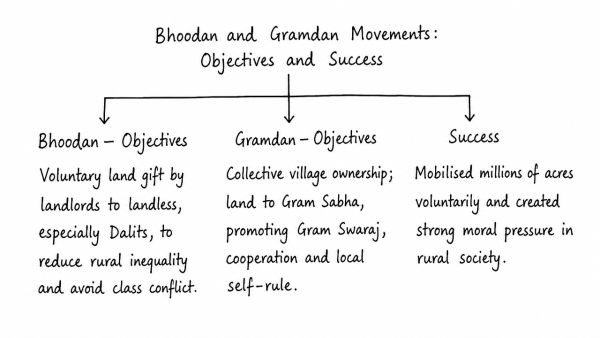
- Bhoodan: induced landlords to donate land to the landless, especially poor and Dalit families, to ease poverty and avoid class conflict.
- Gramdan: aimed at collective village ownership, with land transferred to the Gram Sabha, promoting Gram Swaraj, cooperation and local self-rule.
- Success: It mobilised millions of acres voluntarily and created strong moral pressure in favour of land reform.
- Limitations: Much land was uncultivable, disputed or poorly recorded; only a fraction was actually redistributed.
- Critical view: Without legal backing, survey, mutation and enforcement, donations often remained symbolic. Some landlords used it to evade ceiling laws.
Thus, the movements were important as ethical and political protests against inequality, but they failed to achieve large-scale, durable redistribution. Their real value lay in awakening social conscience and influencing later land reforms.
Originally written on
August 28, 2026
and last modified on
August 28, 2026.