
Glutaraldehyde
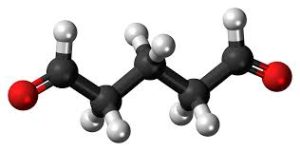
Glutaraldehyde is an organic compound widely used in biochemistry, medicine, material science, and industrial applications due to its strong crosslinking and biocidal properties. Chemically classified as a dialdehyde, it consists of a five-carbon chain terminated at both ends by aldehyde (–CHO) functional groups. This bifunctional structure underpins its high reactivity with biological macromolecules, making it particularly effective as a disinfectant, fixative, and sterilising agent. Although commonly encountered as an aqueous solution rather than in pure form, glutaraldehyde has become a cornerstone chemical in laboratories, healthcare, and industrial settings.
Chemical structure and properties
Glutaraldehyde has the molecular formula C₅H₈O₂. Structurally, it is a straight-chain aliphatic compound with aldehyde groups at both terminal carbons. In aqueous solution, glutaraldehyde does not exist as a single molecular species. Instead, it forms a dynamic equilibrium mixture of free aldehyde, hydrated gem-diols, cyclic hemiacetals, and condensation products. These forms readily interconvert, contributing to the compound’s chemical versatility and biological reactivity.
As a dialdehyde, glutaraldehyde is highly electrophilic and readily reacts with nucleophilic functional groups, particularly primary amines and thiol groups. This property enables it to form stable covalent crosslinks between proteins, nucleic acids, and polymeric materials. The crosslinking action leads to structural rigidification and functional inactivation of biomolecules, which is central to its use as both a fixative and a biocide.
Mechanism of action
The biological activity of glutaraldehyde arises primarily from its ability to react with amino groups present in lysine residues of proteins and nitrogenous bases in nucleic acids. Through condensation reactions, aldehyde groups form imines, commonly known as Schiff bases. Because glutaraldehyde contains two reactive aldehyde groups, it can link two separate molecules together, creating intermolecular or intramolecular crosslinks.
In living cells, this crosslinking disrupts enzyme activity, denatures structural proteins, and interferes with DNA replication and transcription. As a result, cellular metabolism rapidly ceases, leading to cell death. This mechanism explains both its effectiveness as a disinfectant and its utility in preserving biological structures during fixation.
Biochemical and laboratory applications
In biochemistry and cell biology, glutaraldehyde is widely used as an amine-reactive homobifunctional crosslinker. It is particularly valued in microscopy and histology for its ability to preserve fine cellular ultrastructure. In electron microscopy, glutaraldehyde is commonly used as a primary fixative, either alone or in combination with formaldehyde. This initial fixation stabilises proteins and cellular architecture.
A secondary fixation step often follows, using osmium tetroxide to stabilise membrane lipids and enhance contrast. This two-step fixation protocol is essential for high-resolution imaging of cells, tissues, bacteria, and plant material. Beyond microscopy, glutaraldehyde is also used to inactivate bacterial toxins, producing toxoids that retain antigenicity but lack pathogenicity. A notable example is its use in preparing the pertussis toxoid component of combined vaccines such as DPT and Tdap.
Medical and clinical uses
In clinical and healthcare settings, glutaraldehyde is primarily employed as a high-level disinfectant. It is effective against a broad spectrum of microorganisms, including bacteria, viruses, fungi, and bacterial spores. For this reason, it has been widely used to sterilise heat-sensitive medical equipment such as endoscopes and surgical instruments. Commercial formulations are sold under brand names such as Cidex and Glutaral.
In dermatology, glutaraldehyde has limited but specialised medicinal applications. A 10% weight-by-volume solution is used in the treatment of plantar warts, where it acts by drying and hardening the skin, facilitating mechanical removal of the lesion. It is also used under specialist supervision to treat palmar and plantar hyperhidrosis in patients who do not respond to first-line therapies such as aluminium chloride. In this context, glutaraldehyde reduces sweating by denaturing proteins in sweat ducts.
Applications in material science
Glutaraldehyde plays an important role in material science due to its strong crosslinking capacity. It is widely used as a fixing agent in the preparation of biomaterials prior to microscopic or spectroscopic characterisation. Polymers containing primary amine groups, such as chitosan, gelatin, and collagen, can be effectively crosslinked with glutaraldehyde to enhance mechanical strength, chemical stability, and resistance to degradation.
In coatings technology, glutaraldehyde has been used as an interlinking agent to improve adhesion between polymeric layers. It also finds application in corrosion protection, particularly for undersea pipelines, where it helps inhibit microbial growth and material degradation. These uses highlight its versatility beyond strictly biological contexts.
Other uses
Outside laboratory and medical environments, glutaraldehyde is sometimes encountered in niche applications. In aquaria, dilute glutaraldehyde solutions are marketed as alternatives to carbon dioxide injection systems for aquatic plants. However, such products do not increase dissolved carbon dioxide levels and lack intrinsic properties that stimulate plant growth. Instead, aquarists commonly use low concentrations of glutaraldehyde as an algicide, exploiting its biocidal effects to control unwanted algae.
Safety and health considerations
Despite its usefulness, glutaraldehyde is a hazardous substance that requires careful handling. It is a strong irritant to the skin, eyes, and respiratory tract. Acute exposure may cause dermatitis, nausea, headaches, and shortness of breath, particularly in poorly ventilated environments. Prolonged or repeated exposure can lead to occupational asthma and chronic skin sensitisation.
Protective equipment, including gloves, eye protection, and adequate ventilation, is strongly recommended when working with glutaraldehyde, especially at high concentrations. While there is no conclusive evidence that glutaraldehyde is carcinogenic, some occupational studies have reported increased cancer risks among workers with long-term exposure, underscoring the importance of strict safety controls.
Production and industrial synthesis
Industrially, glutaraldehyde is produced primarily through the catalytic oxidation of cyclopentene using hydrogen peroxide. This process is typically carried out in the presence of tungstic acid-based heteropoly acid catalysts and is chemically analogous to ozonolysis. An alternative synthetic route involves a Diels–Alder reaction between acrolein and enol ethers, followed by hydrolysis to yield the dialdehyde.
These production methods are designed to achieve high yields while maintaining control over purity, as impurities can significantly affect reactivity and safety in downstream applications.
Chemical reactions and reactivity
In aqueous environments, glutaraldehyde readily hydrates to form gem-diols, which equilibrate with cyclic hemiacetals. Under alkaline conditions, monomeric glutaraldehyde can undergo aldol condensation and Michael addition reactions, leading to the formation of α,β-unsaturated polyglutaraldehyde and related oligomers. These polymerisation reactions influence both the stability and reactivity of glutaraldehyde solutions over time.
Like other aldehydes, glutaraldehyde reacts readily with primary amines and thiol groups, making it an effective crosslinker for proteins, nucleic acids, and synthetic polymers. This bifunctional reactivity explains its potent fixative and sterilising properties, as well as its wide applicability across scientific and industrial fields.



sapna rai
January 4, 2018 at 12:01 pmit was really helpful