Supreme Court Upholds Online Gaming Laws and GST
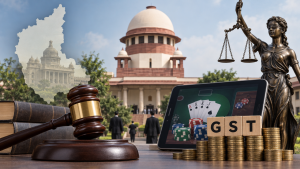
On 27 May 2026, the Supreme Court of India upheld the constitutional validity of Karnataka and Tamil Nadu laws restricting online games played for money or stakes. A bench of Justices J.B. Pardiwala and R. Mahadevan delivered the judgment.
Scope of the ruling
The ruling covers skill-based games such as rummy and poker when played for stakes. The Court held that once betting or wagering is involved, whether a game is based on skill or chance is no longer central to its regulation. It also stated that there is no fundamental right to engage in betting and gambling, and affirmed states’ power to regulate or prohibit these activities on public order and welfare grounds. The judgment set aside earlier decisions of the Madras High Court and Karnataka High Court that had struck down portions of the state laws.
GST on online gaming
The Court upheld the constitutional validity of GST on organised online gaming involving money stakes, including the 28% levy on the full face value of each bet placed on a platform. It treated the 2023 GST amendment as clarificatory, implying retrospective application.
Important Facts for Exams
- Judicial review: The Supreme Court can invalidate ordinary laws and constitutional amendments through judicial review, applying the basic-structure doctrine it developed in the 1960s and 1970s.
- Binding decisions: The Supreme Court’s decisions bind other Indian courts as well as the Union and state governments.
- State-list gambling competence: Entry 34 of the Constitution’s State List assigns betting and gambling to state legislatures, while Entry 40 of the Union List concerns government-organised lotteries.
- Skill-game statutory exception: Section 12 of the Public Gambling Act, 1867, says its provisions do not apply to games of mere skill, wherever played.
| Related | |
|---|---|