Supreme Court Bars Punitive Action in NALSAR Protest Row
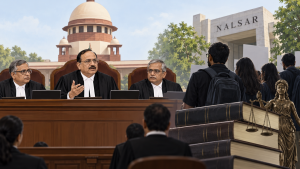
On August 14, 2026, the Supreme Court directed the Bar Council of India (BCI) and State Bar Councils not to take punitive action against students or faculty of any law university over the NALSAR protest controversy in Telangana.
Supreme Court hearing
A bench headed by Chief Justice of India Surya Kant, with Justices Joymalya Bagchi and V Mohana, heard the matter. Surya Kant affirmed students’ right to peaceful protest and questioned the BCI’s intervention, describing the issue as a dialogue between him and the students.
BCI circulars withdrawn
The controversy followed NALSAR University of Law students in Hyderabad opposing a proposal to invite Surya Kant as chief guest at their convocation, citing his remarks on alleged police action against protesters. On August 13, the BCI issued circulars restricting enrolment of NALSAR’s 2026 graduates as advocates. During the hearing, its counsel informed the court that the circulars had been withdrawn. BCI Chairman Manan Kumar Mishra had initially issued them. As of August 14, an inquiry, including a report awaited from the NALSAR Vice-Chancellor, remained pending, although the BCI announced closure of proceedings against the entire 2026 batch.
Important Facts for Exams
- Statutory remit: The Bar Council of India is a statutory body under the Advocates Act 1961, regulating legal practice and legal education.
- State-level enrolment: State Bar Councils enrol eligible holders of recognised law degrees; the Advocates Act empowers them to frame their own enrolment rules.
| Related | |
|---|---|