Scientists Identify Two New Australian Stick Insect Species
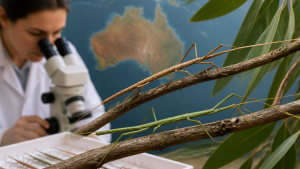
Scientists identified two new Australian stick insect species in 2026 after re-examining members of the genus Anchiale. The study also reinstated one previously unrecognised species and revised the group from two species to five distinct species.
Genus Anchiale
Anchiale is a genus of stick insects in the order Phasmatodea. Stick insects are known for elongated bodies, leaf-like camouflage, and egg forms that are often used in species identification.
Newly Described Species
The two newly described species are Anchiale mabiensis and Anchiale robusta. Anchiale mabiensis was found in Queensland’s Mabi rainforest on the Atherton Tablelands, while Anchiale robusta had been misidentified for decades.
Egg Morphology and Taxonomy
Anchiale mabiensis lays eggs with a unique structural lid and inner rings. This egg structure had not been recorded earlier in any stick insect or in its closest relatives, and it formed one of the key taxonomic features used in the study.
Important Facts for Exams
- Stick insects belong to the order Phasmatodea, which includes insects adapted for camouflage.
- The genus Anchiale is part of the Australian stick insect fauna.
- Taxonomy uses morphology, DNA analysis, and museum specimens to classify species.
- Citizen science observations can support biodiversity surveys and species documentation.
Research Methods and Distribution
The research used DNA analysis, museum specimens, field surveys, citizen science observations, and insects raised in captivity. More than 1,000 observations were used in the study, and the revised species range extends from northern New South Wales through coastal Queensland to tropical northern Australia.
Publication and Conservation Context
The findings were published in Austral Entomology on 21 September 2026. Anchiale mabiensis was recorded from the critically endangered Mabi rainforest, a lowland tropical rainforest ecosystem in Queensland.
| Related | |
|---|---|